Autore: lapollaz

  • How to Read a Photograph

    How to Read a Photograph

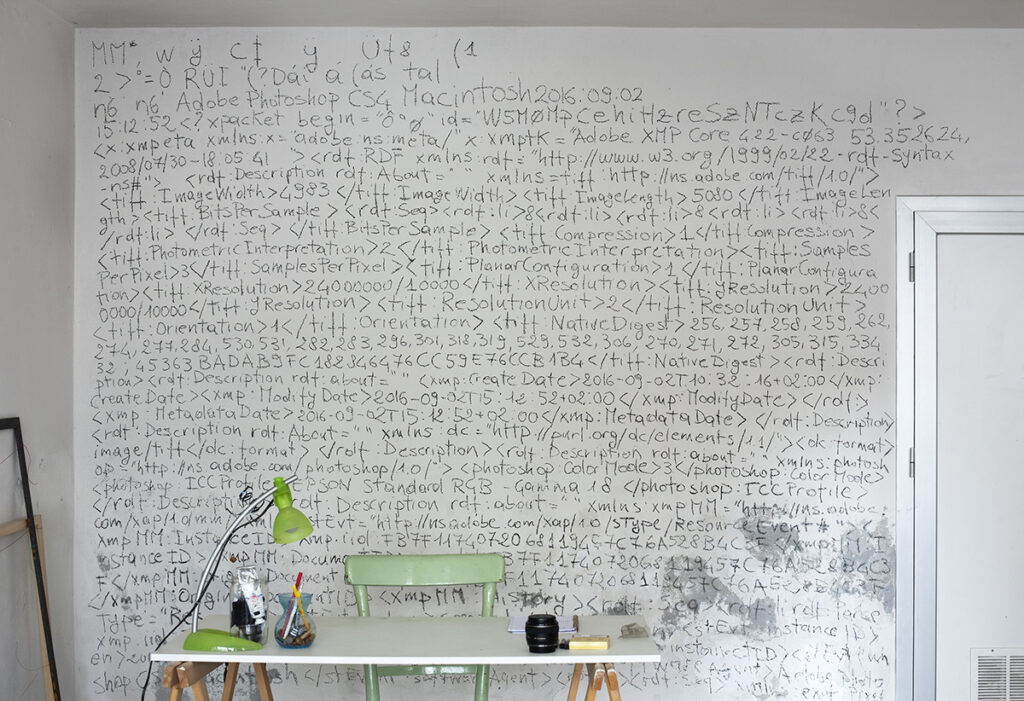
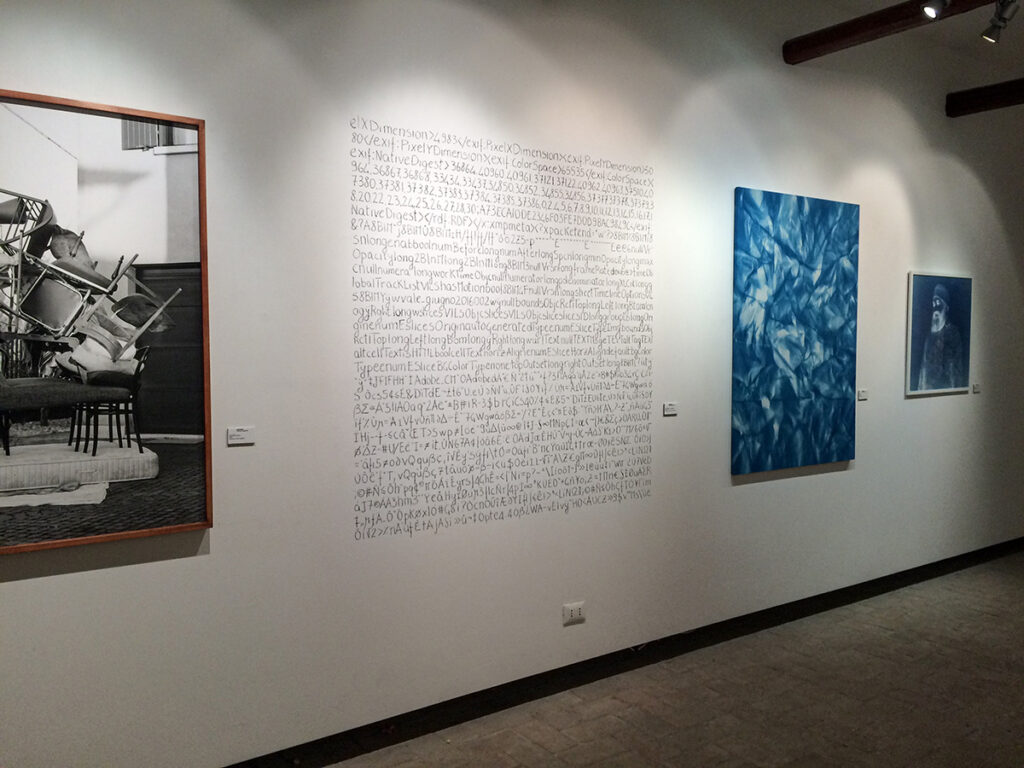
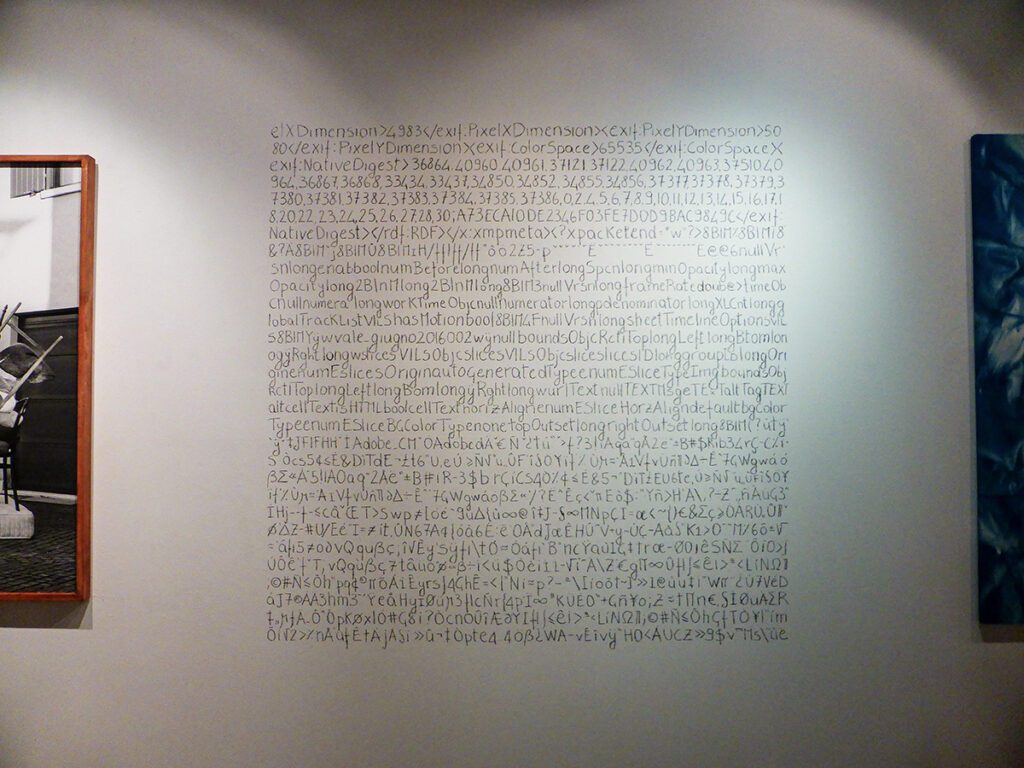
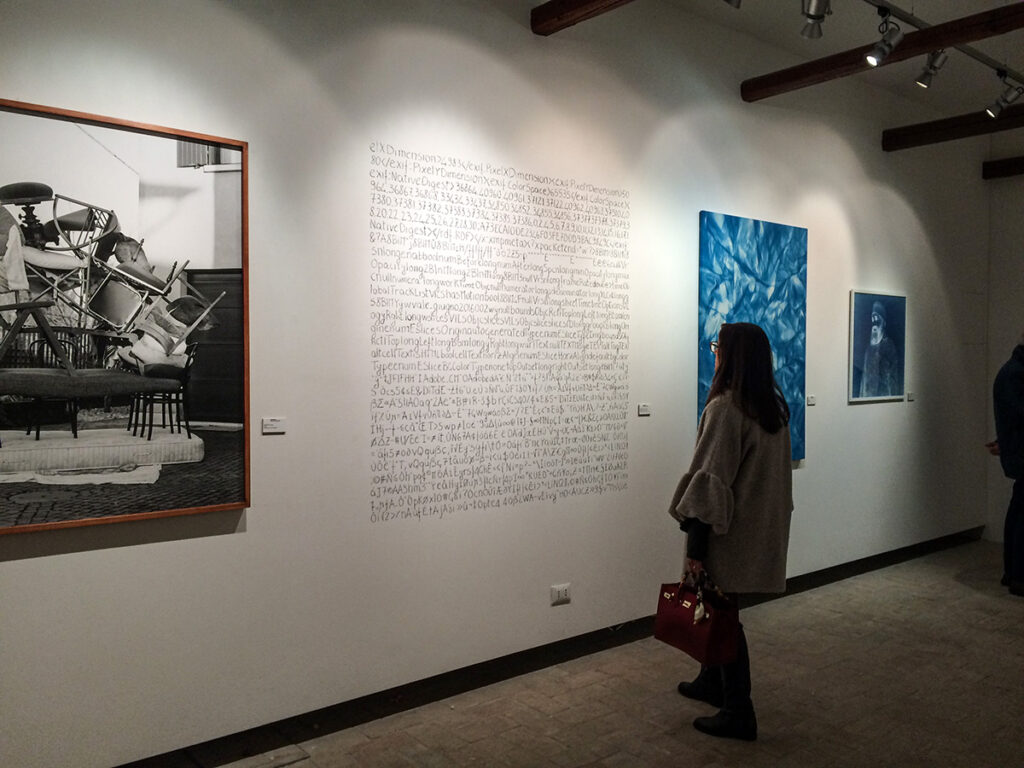
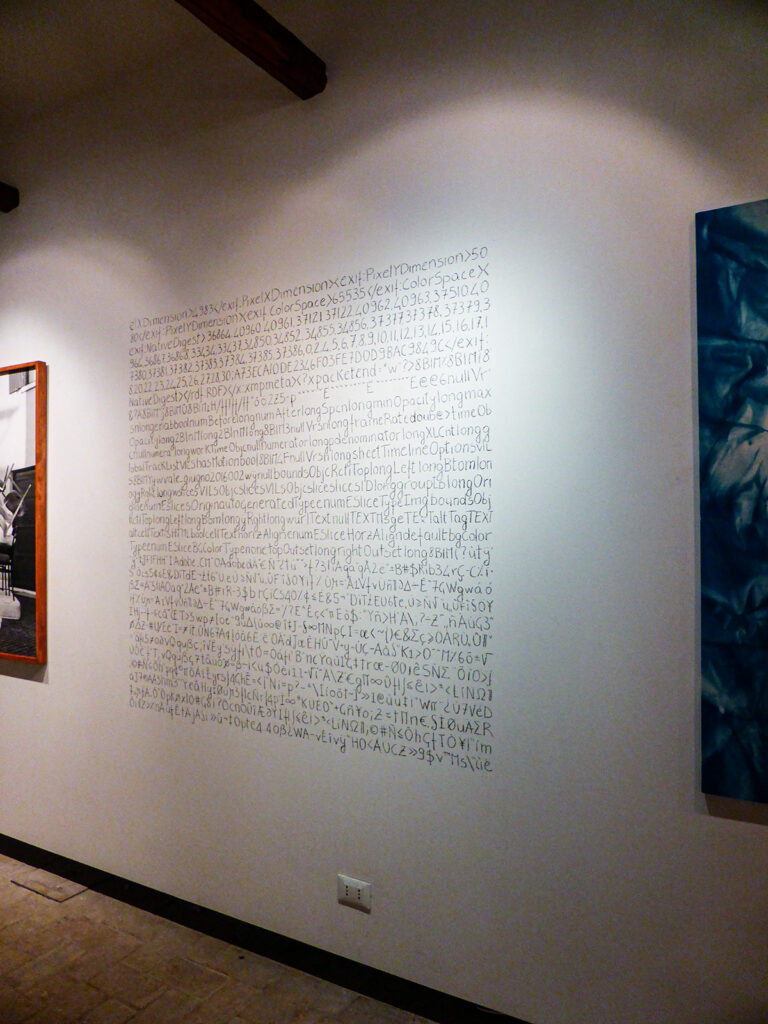
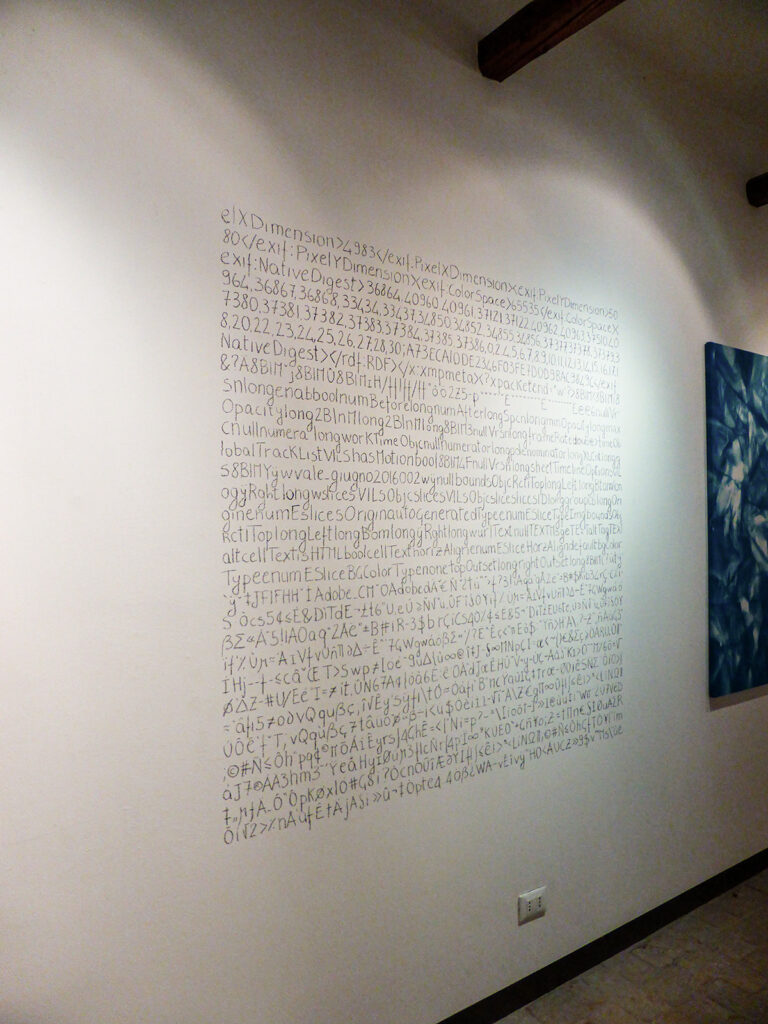
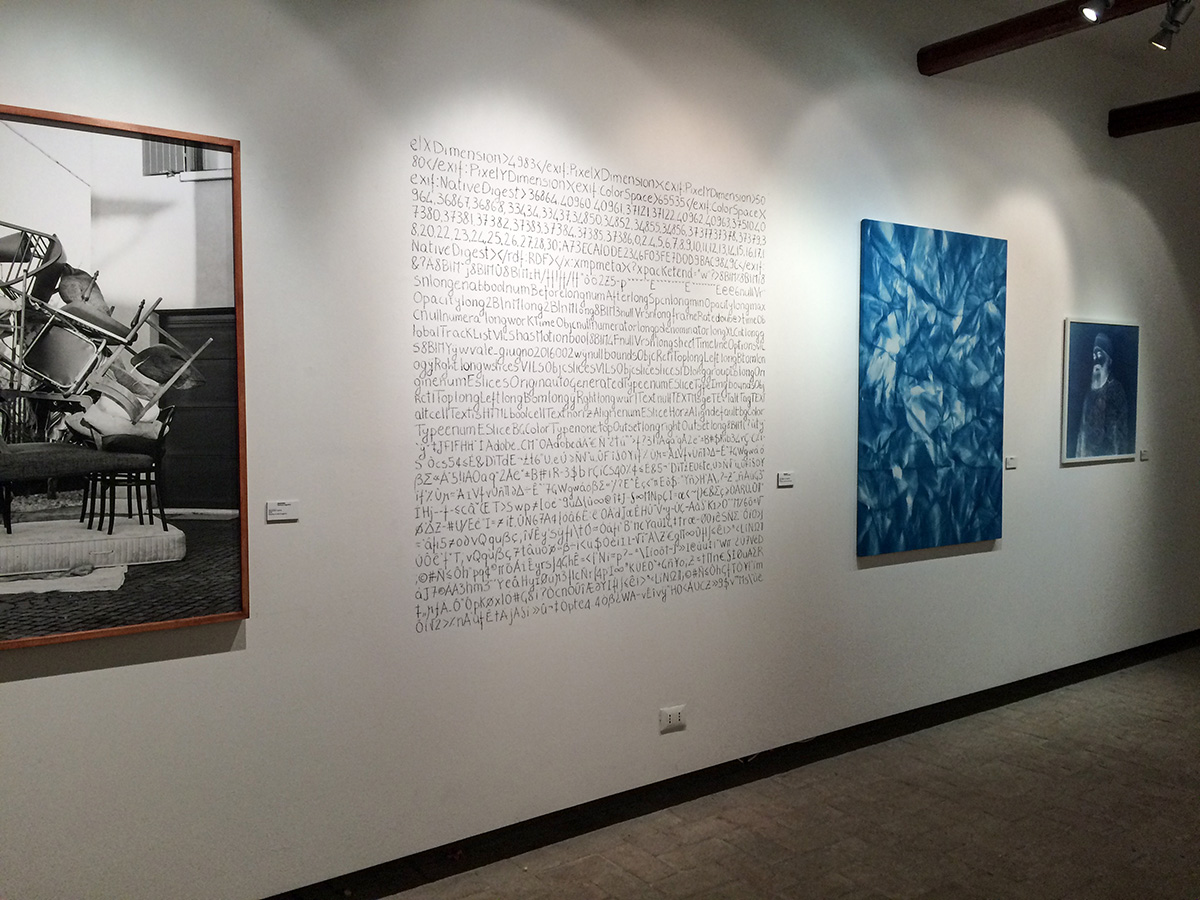
    How to Read a Photograph is a photograph written by hand. By opening the digital file of an image and viewing its contents as text, I found myself faced first with metadata and then with ASCII code. Writing this text onto the wall of my studio with a black pastel pencil, like during a school examination at the blackboard, became both a possible answer to the question posed by the title and an attempt to enter the photograph through its mysterious language, using the physical gesture of writing on the wall.

    Whether a photograph can still be defined as a photograph or becomes a point of contact between different forms of writing remains an open question.

    The complete textual encoding of the image is extremely long, and the original idea was to transcribe it progressively through a series of installations, each presenting a consecutive section of the file until the entire photograph had eventually been rewritten by hand.

    The work was first realized on an entire wall of the studio. A fragment of this ongoing transcription was later adapted to the 150 × 150 cm format of the Premio Fabbri per la Fotografia 2018, where it was selected by the jury and exhibited as part of the competition.

    24.11.2018 @Villa Brandolini, Pieve di Soligo, Premio Fabbri 2018

  • Vaguement (Clinker)

    Vaguement (Clinker)

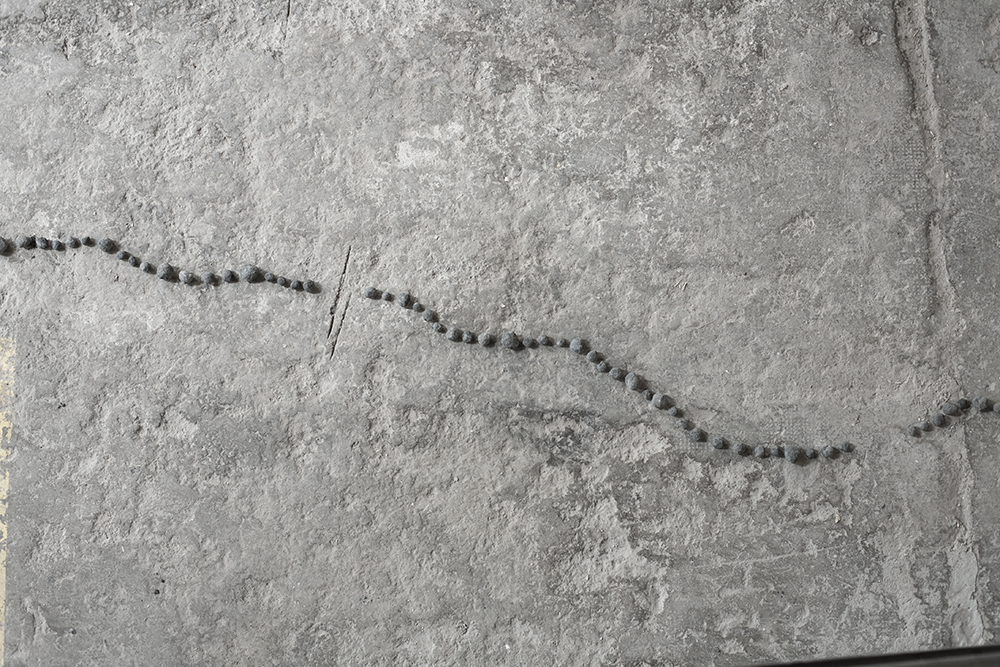
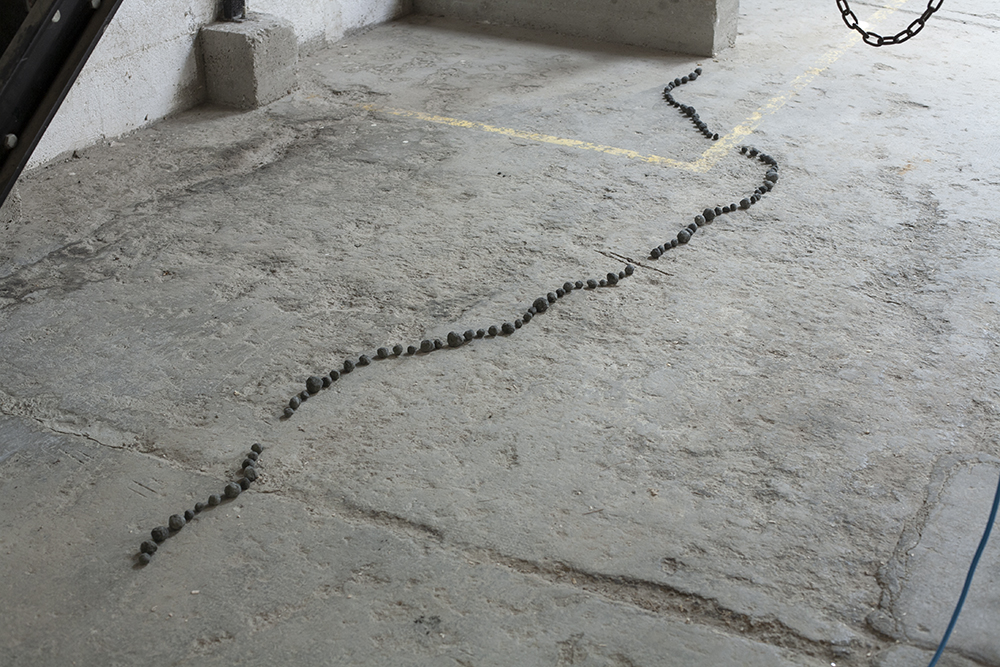
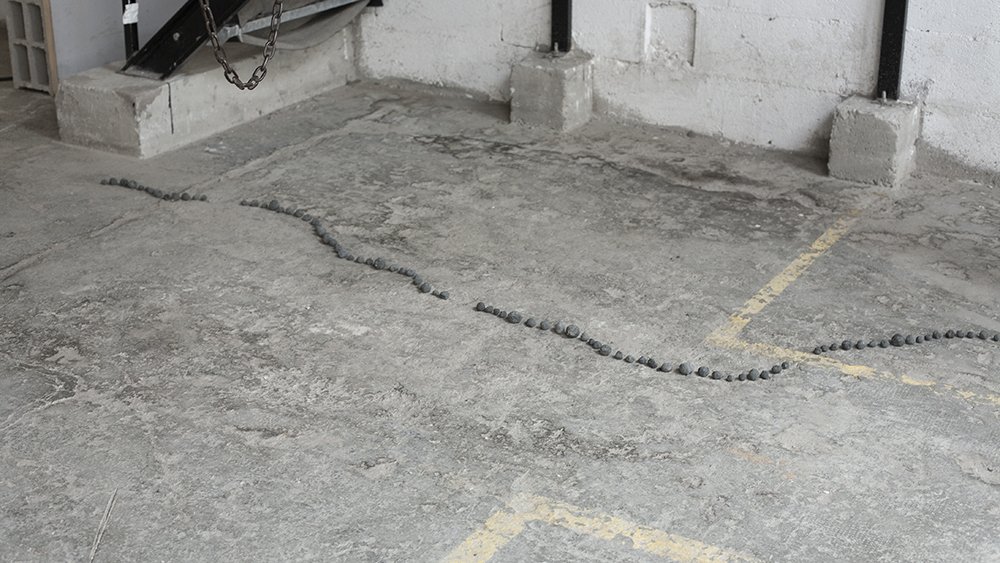
    Vaguement (Clinker), clinker lumps, variable dimensions, 2018

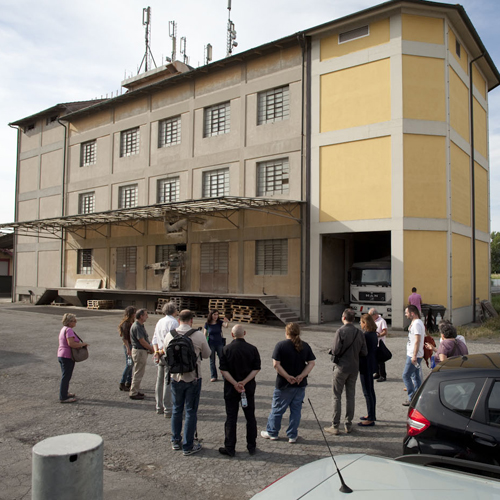
    Vaguement (clinker) is a work developed during my staying at La Déviation, a former production plant for concrete and lime (called formerly La Coloniale) and actually a self-organized space for research on living and visual arts, where people live and work together sharing a common and political idea against private property. The site is surrounded by white and steep cliffs and occasionally you can hear little rocks falling down the metastable hills shaped by the extraction activity, while the Mistral wind makes oscillate all the wild plants all over: at the same time people down in the workshop site work all day long to take care of the site, to make artistic research and keep the community alive.

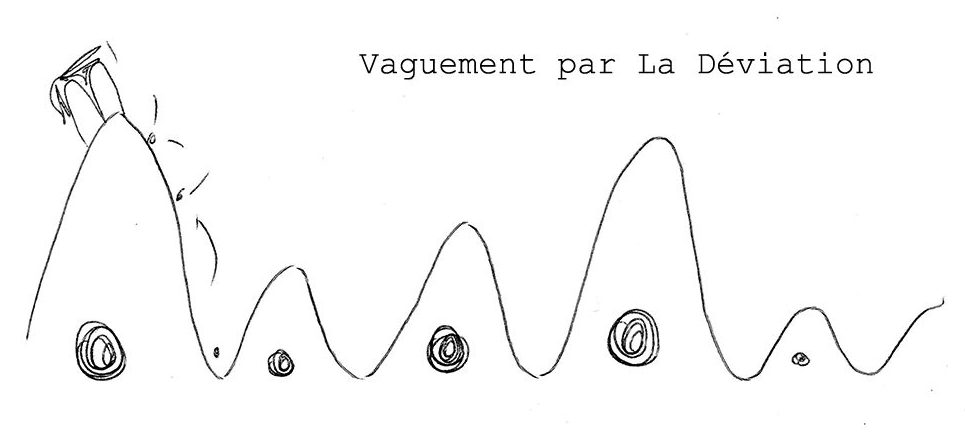
    From a concrete production plant in Italy I took with me a bucket of clinker, a basic product in the manufacture of cement, produced by sintering limestone and clay materials. I used this material to work on and study the rhythm and movement in La Déviation. As clinker is formed by black, powder lumps between 3 and 25mm in diameter, aligning them one after the other with their different dimensions, makes me able to resemble patterns and frequencies that I observed and heard around me. Moreover the sinuous shape of the cliffs inspired me for the overall movement of this almost living creature that has to feel out the ground to adjust its direction.

    The work is part of the event Potlatch.

  • Phosgene

    Phosgene

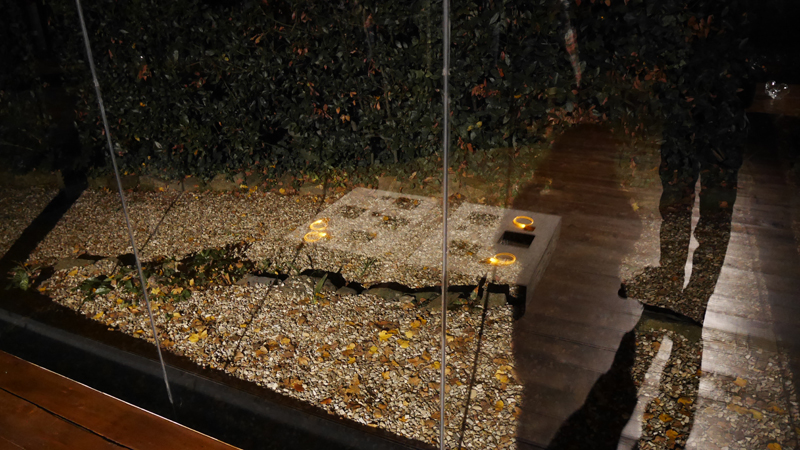
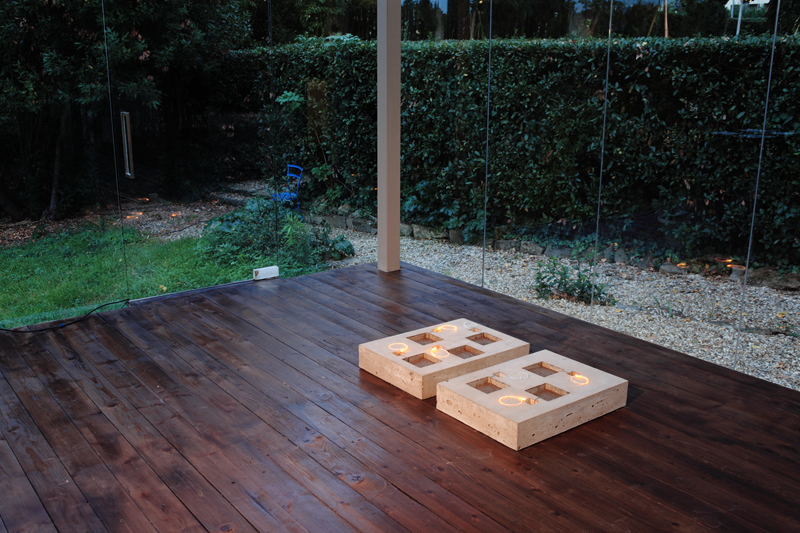
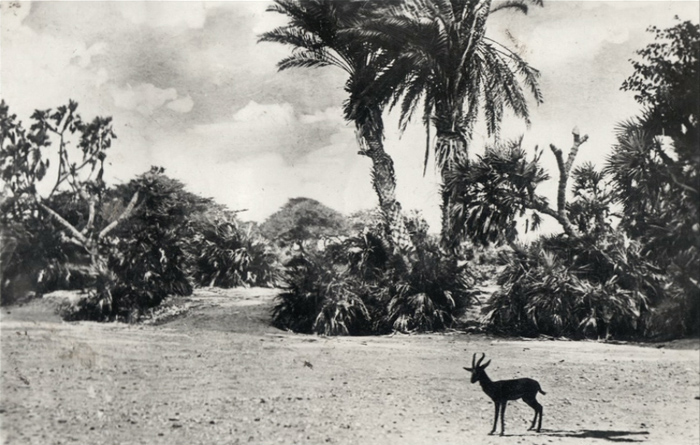
    Phosgene is a highly toxic and poisonous chlorine compound. This gas owes its name, which literally means “born of light”,  to the  role that light plays in the transformation of chloroform into phosgene. It was one of the chemical forbidden gases used by the Italian army during the Second Italo-Ethiopian War (1935-1936). Since my great-uncle was a soldier in that war, I dedicated a trilogy to the three main chemical gases (arsine, hyperite and phosgene) used in that  fascist and colonial war.

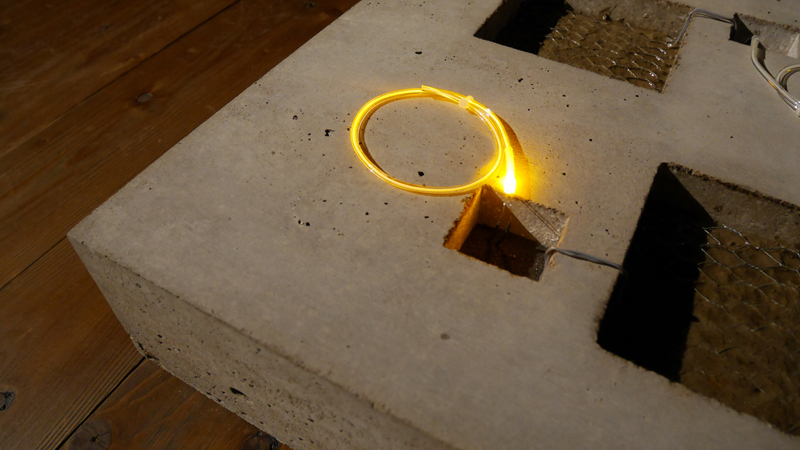
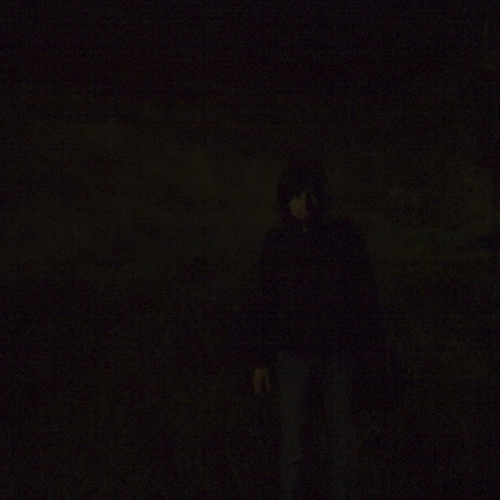
    The work is a porous concrete sculpture, reminiscent of the shape of a grave, which houses some circles of light that pulsate following the rhythm of the energy produced through anaerobic respiration by bacteria living in the soil of the microbial fuel cells. The shape of the work is inspired by a blurry photo found in a family album with images of the colonial war. In this work voids and pores, death, personal and collective history, chemical transformations and microbial life are evoked together. 

    The work has been conceived for the project Skūmaz – a metastable state, developed together with Rachel Morellet, Eva Sauer and Tatiana Villani, with a critical text by Eleonora Farina.

    Photo by Andrea Abati, Rachel Morellet

  • Pollicina

    Pollicina

    It’s a Pleasure to Speak with You, Pollicina

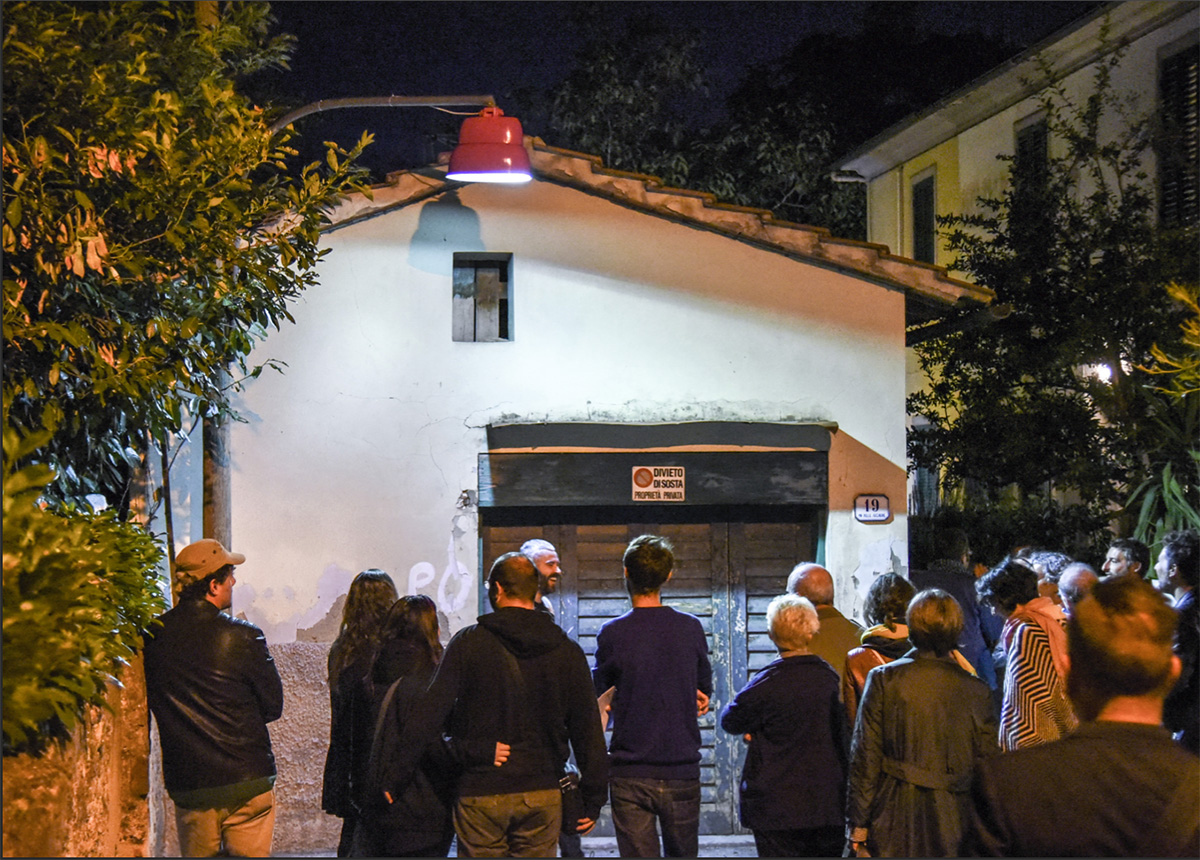
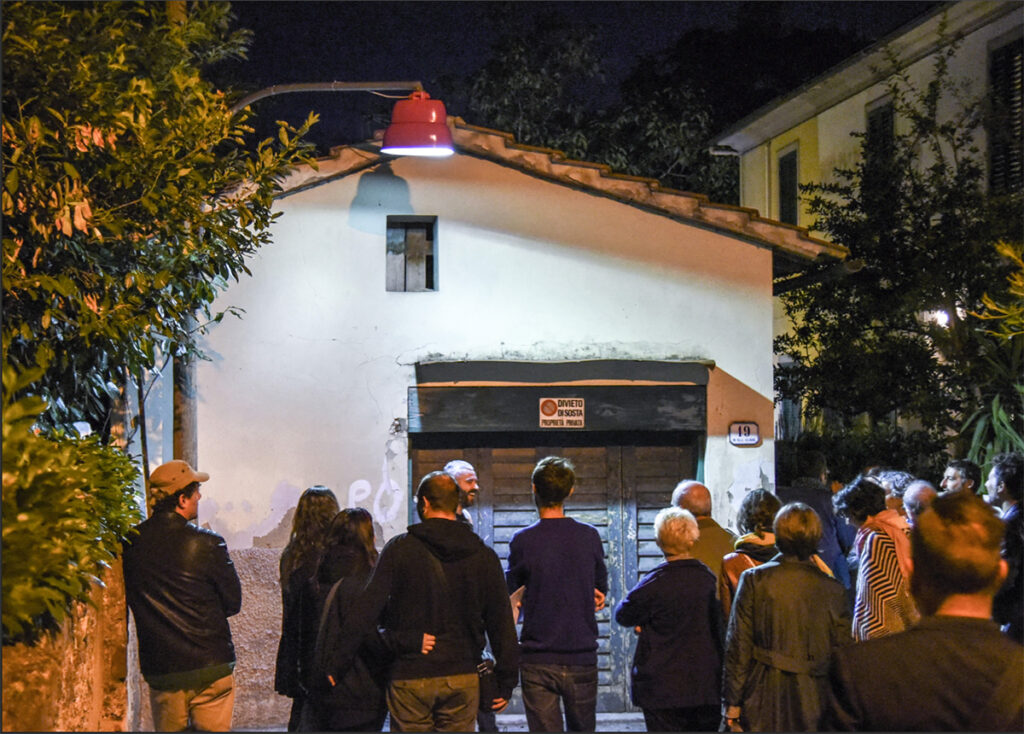
    Pollicina is a light and sound installation that emerges from a reflection on the everyday life of Via delle Segherie, a street in Prato crossed daily by different languages, cultures, and trajectories.

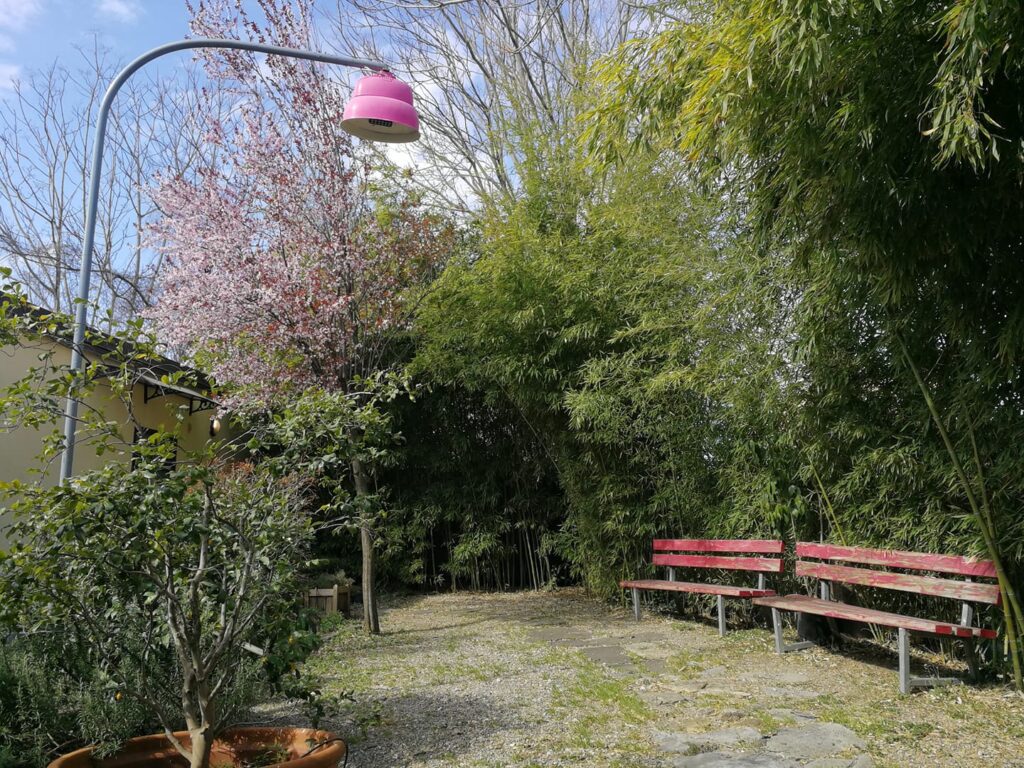
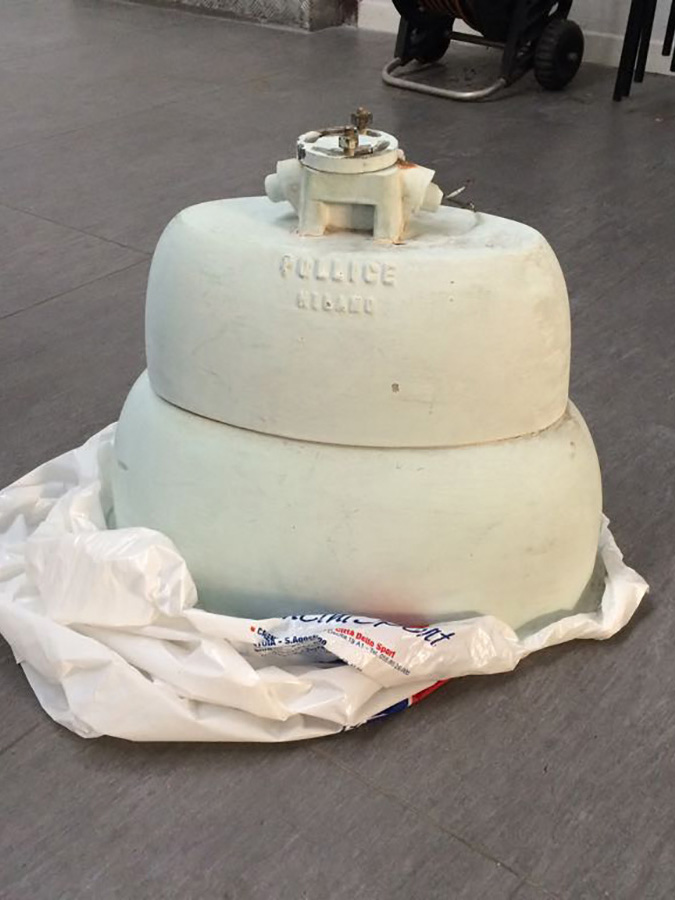
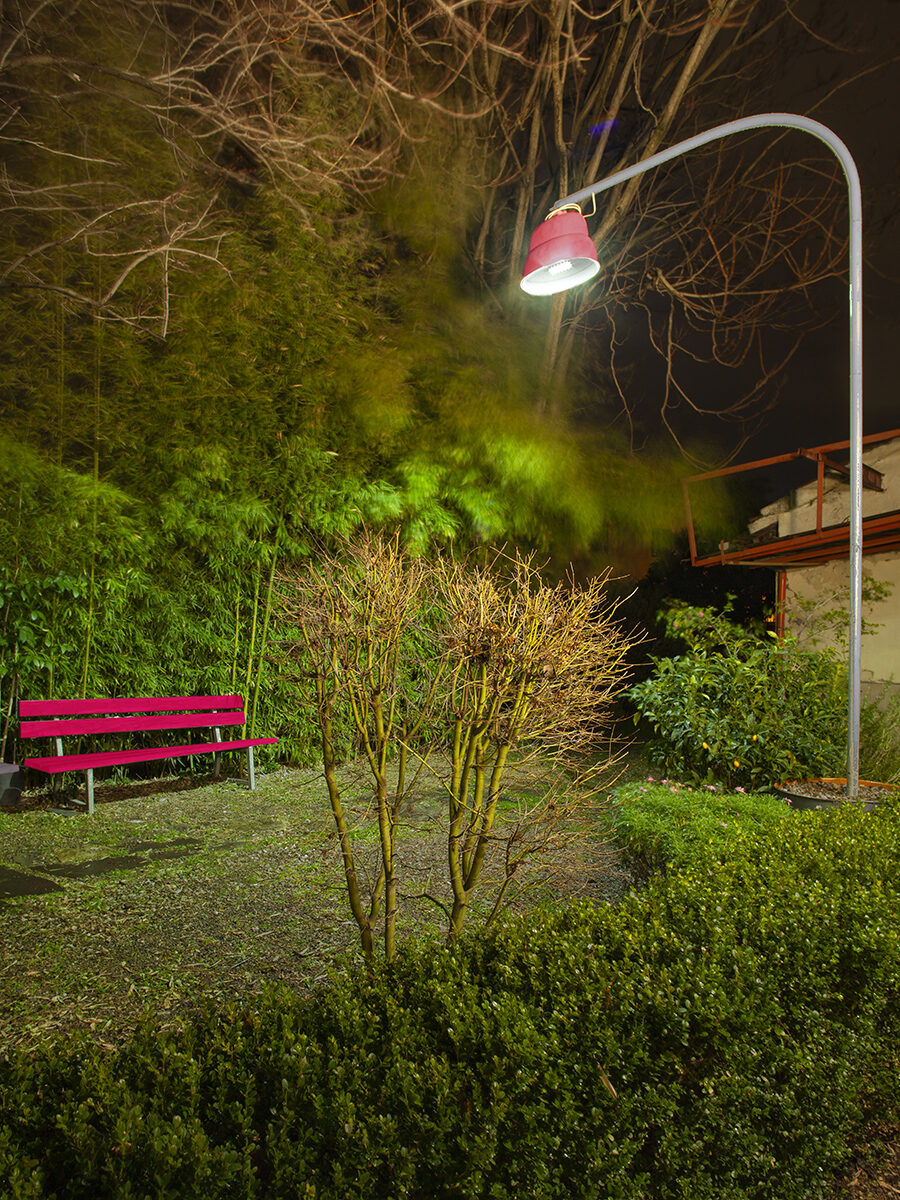
    The work takes shape from an old streetlamp, decommissioned due to obsolescence, which was recovered and transformed into a poetic object. Painted in vivid fuchsia, it appears as a kind of enchanted lamp capable of speaking. The name Pollicina derives from Pollice, the name of the lamp’s original manufacturer, still engraved on its structure.

    As people walk by, the lamp is activated and speaks short, mysterious, and divinatory sentences in different languages. These are gentle wishes, auspicious messages, and evocative fragments reminiscent of fortune cookies or the messages hidden inside Baci Perugina chocolates. Speaking in different languages, Pollicina reflects the multilingual everyday life of Via delle Segherie, transforming a discarded urban object into a small device for encounter, imagination, and hospitality. A simple gesture creates a moment of suspension within the urban routine: an unexpected encounter, a luminous pause inviting reflection on the next step.

    The work emerged from a collective project promoted by the many people who co-form Dryphoto Arte Contemporanea and was commissioned for MLZ – Via delle Segherie, curated by Alba Braza. Since 2020, Pollicina has been permanently installed in Giardino Melampo, Prato, a shared public space conceived by Andrea Abati.

  • Taffeta

    Taffeta

    Taffeta, sewable conductive wire, led, micro-controllers, el-wire, batteries, clothes, jewels, 2017

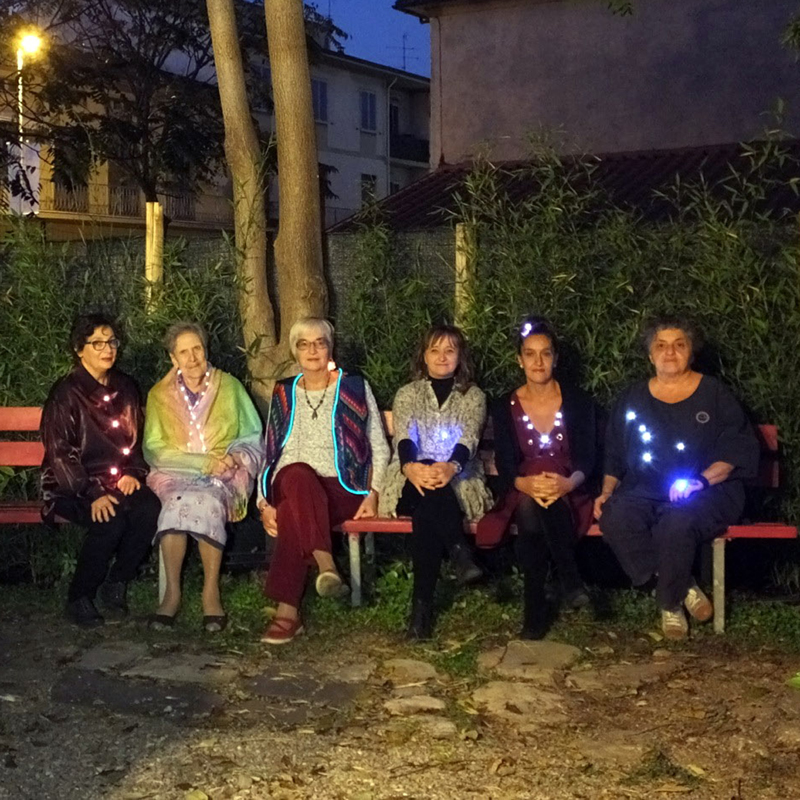
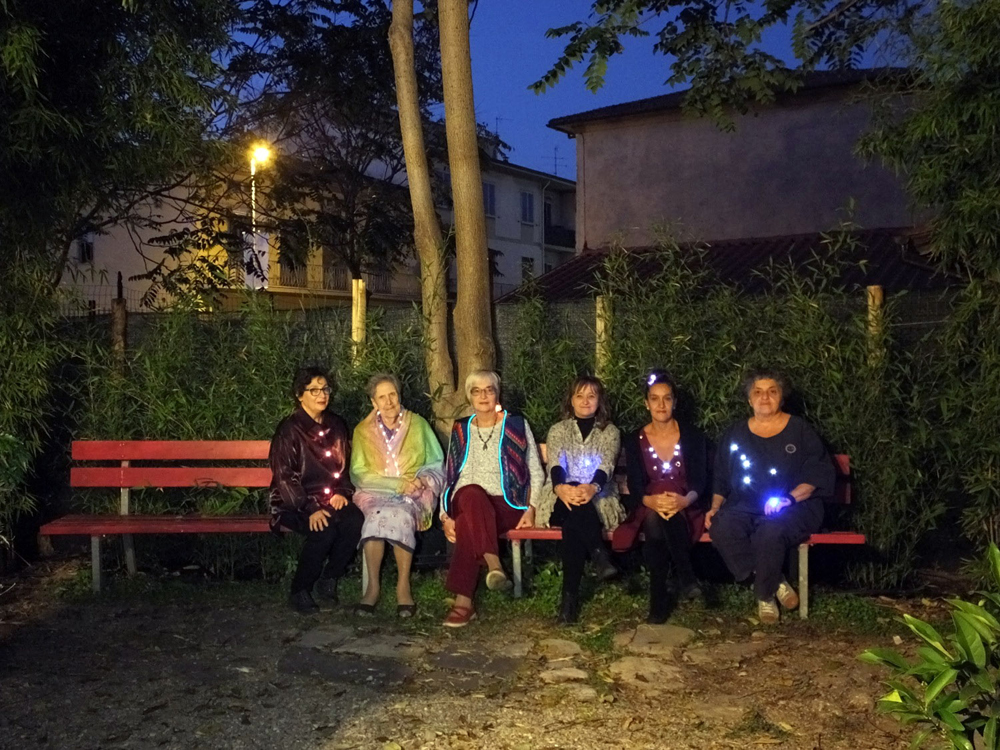
    A neighborhood perceived as insufficiently lit by its inhabitants in Prato, Italy, is the starting point of this project. The feeling of darkness was associated by the residents with insecurity and crime: the people who lived there felt essentially abandoned by the local authorities. So I conducted a workshop on wearable technologies and we developed and sewed clothes and accessories together, as a personal and collective response to the feeling of fear and discouragement.

    The work consists of dresses with lights and sensors, and some accessories. The favorite clothes and jewels of the eight women who took part in the process were the starting point of the collective work: together we learned to design and sew wearable LEDs, conductive thread and flexible circuits. The whole process was very engaging and fun.

    The final works were worn by the women during the opening night of the Piazza dell’Immaginario exhibition, for which the work was conceived.

    The exhibition is part of Piazza dell’Immaginario, a multi-year project by Dryphoto Arte Contemporanea, Prato, curated by Alba Braza, that conceives contemporary art as a way to involve people coming from any part of the world and from any cultural social and economic background.

    See here for the publication.

    Production Assistant: Costanza Abati

    Photo: Andrea Abati, Eva Sauer, Valentina Lapolla

    Technical sponsor: Elfi srl

  • Should I have described Juliette or the leaves? It was really impossible to describe both, so let us just say that the leaves and Juliette fluttered gently in that late October afternoon.*

    Should I have described Juliette or the leaves? It was really impossible to describe both, so let us just say that the leaves and Juliette fluttered gently in that late October afternoon.*

    Juliette or the leaves, Led lights, electric wire, conductive threads, metal beads, self made electronic circuit, 2017

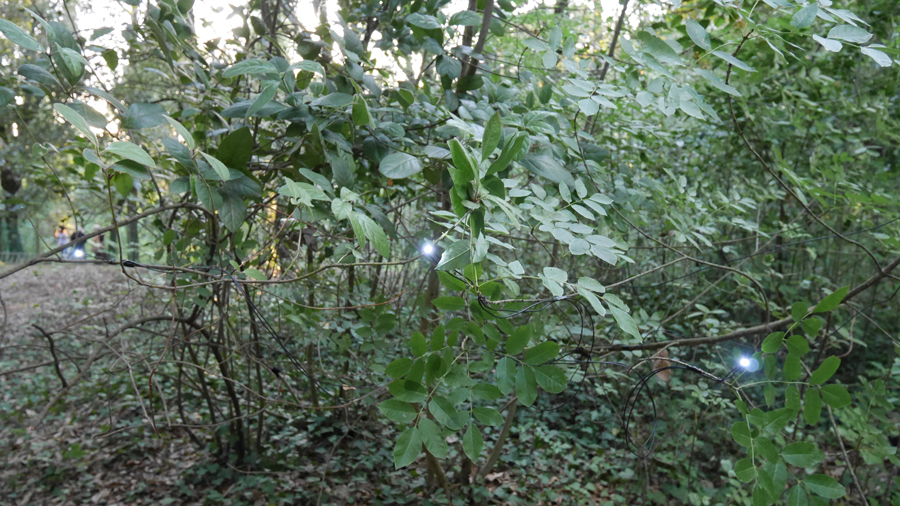
    During the event Un sentiero di segni organized by Sincresis Arte Contemporanea, I put some little led lights on the branches of some bushes: they turn on only when two metal beads suspended by a conductive thread touch each other because of the action of the wind. The random pulsating signal is the effect of the wind and the random configuration and oscillation of the suspended threads.

     ——————————-
    * Jean Luc Godard, Two or Three Things I Know about her.
  • 9000 stitches per minutes

    9000 stitches per minutes

    9000spm

    9000 spm, wearable device, 2016

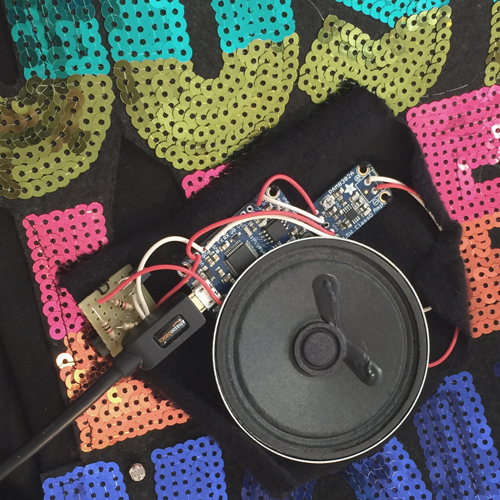
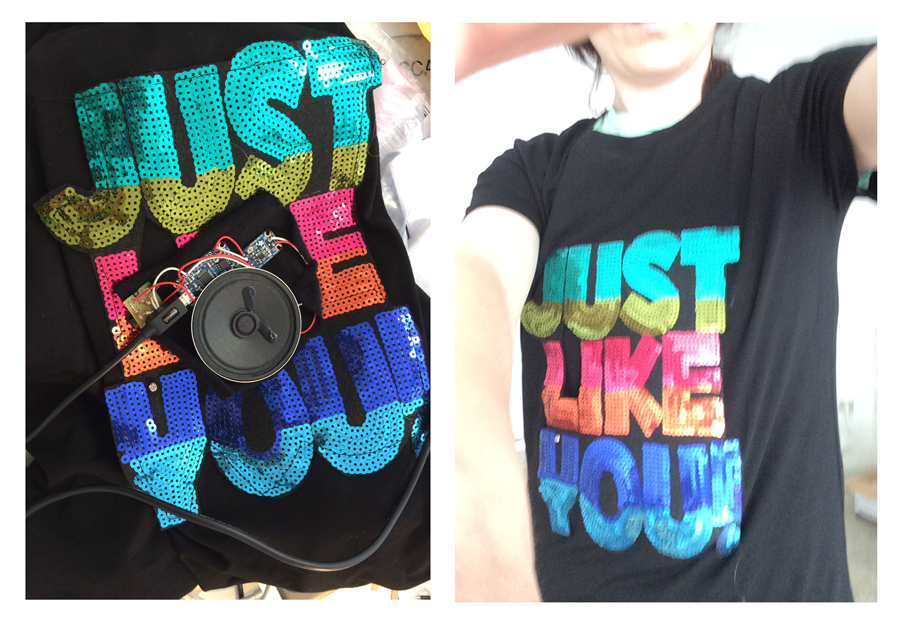
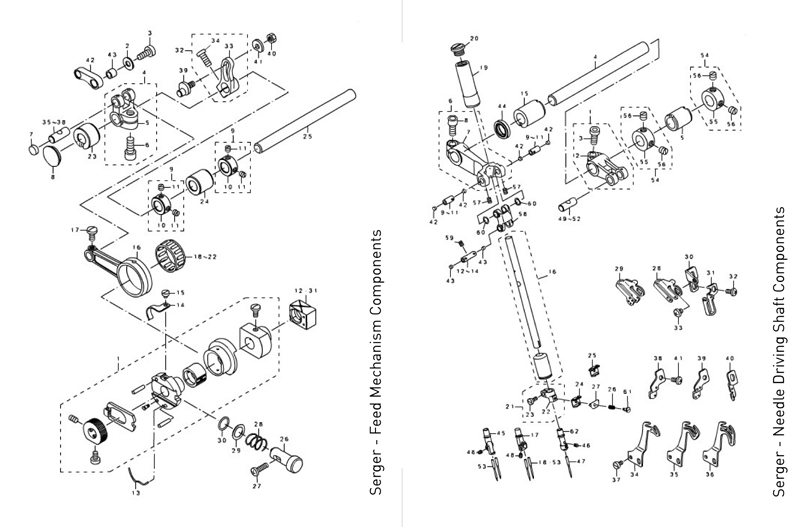
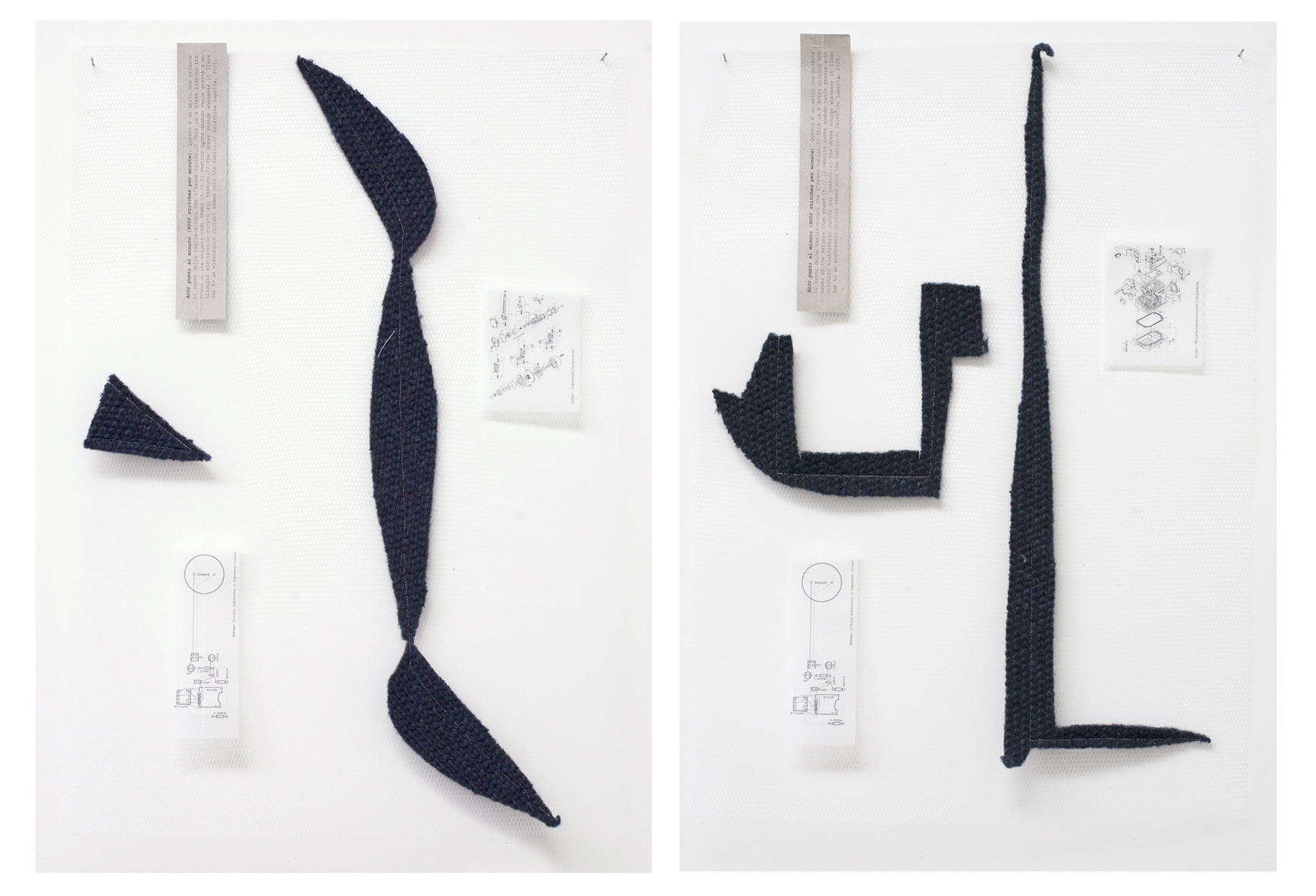
    9000 spm (9000 stitches per minutes the maximum operational rate of many sergers) is a wearable device that makes every dress able to play the sound of the machines that produced it, due to an electronic circuit sewed onto the fabric.

    First conceived and shown as an invisible audio installation (Ghost Track, 2015) reproducing the sound of sewing machines and sergers, as an evocation of the the ghost work of the textile industry of my own city, it turned up in a wearable device that reminds you where your dress comes from. Before being implemented 9000spm was produced as a project (BAU2016) in 150 variations making use of the production scraps of the cutting processes by a ‘pronto moda‘, a super fast fashion chain of production.

    You can see a video of the wearable device here.

    prova

    BAU

  • Fellowship

    Fellowship

    Fellowship, A4 black and white printed paper, 6 color little sticks, 2013-2016

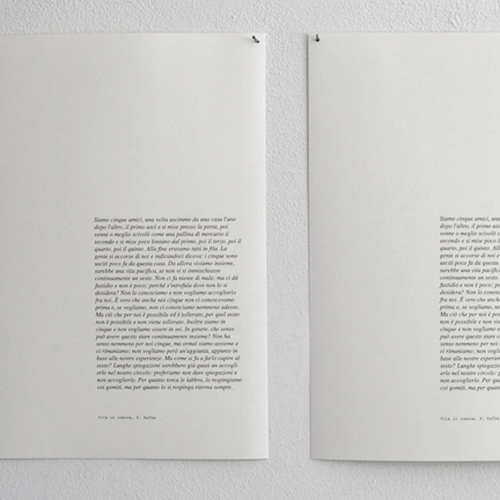
    In Kafka’s short story Fellowship, five people appear to enjoy being a group, but when a sixth person hopes to join, he is refused admittance: it is a parable about the paradox of being a group, a community, where someone is always left out.

    So I printed this story on six identical pages and put it in a row, with the sixth page a bit far than the other.

    Fellowship

    We are five friends; one day we came out of a house one after the other; first one came and placed himself beside the gate, then the second came, or rather he glided through the gate like a little ball of quicksilver, and placed himself near the first one, then came the third, then the fourth, then the fifth. Finally we all stood in a row. People bagan to notice us; they pointed at us and said: those five just came out of that house. Since then we have been living together; it would be a peaceful life if it weren’t for a sixth one continually trying to interfere. He doesn’t do us any harm, but he annoys us, and that is harm enough; why does he intrude where he is not wanted? We don’t know him and don’t want him to join us. There was a time, of course, when the five of us did not know one another, either; and it could be said that we still don’t know one another, but what is possible and can be tolerated by the five of us is not possible and cannot be tolerated with this sixth one. In any case, we are five and don’t want to be six. And what is the point of this continual being together anyhow? It is also pointless for the five of us, but here we are together and remain together; a new combination, however, we do not want, just because of our experiences. But how is one to make all clear to the sixth one? Long explanations would almost amount to accepting him in our circle, so we prefer not to explain and not to accept him. No matter how he pouts his lips we push him away with our elbows, but however much we push him away, back he comes. (translated by Tania and James Stern)

    Initially conceived for the exhibition Should I stay or should I go? (Sincresis Contemporary Art, Empoli, 2013) as a wall installation, in 2016 the printed pages were hosted in the public library of Suzzara (during the 49th Suzzara Prize), while six little sticks of different colors spreading all over streets and places of this little town.


    This story is also the point of departure for the sound installation project COMUNIDAD – O como distinguir los pistachos, developed for the Biennal de Mislata Miquel Navarro.
  • Chincaglierie (Trinket)

    Chincaglierie (Trinket)

    _mg_2743

    One of the necklace’s small stones was tardy. Traveling on One Leg by Herta Muller

    Chincaglierie (Trinket) is a kinetic installation that transforms recorded sound into vibration, movement, and unstable material resonance.

    The work originated in 2015 in dialogue with Weave Along, a participatory action by artists Tatiana Villani, Manuela Mancioppi, and Emanuela Baldi, developed through the collective weaving of textile scraps and discarded materials gathered from local industries in Prato. Invited to document the process, I recorded the voices, gestures, footsteps, frictions, tears, rustles, and mechanical sounds produced throughout the action, collecting the sonic traces of a collective experience unfolding over time.

    These recordings later became the basis for an electronic system specifically designed to transform sound into physical vibration. Through custom-built circuits, audio frequencies are converted into electrical impulses capable of activating vibration motors and small mechanical devices.

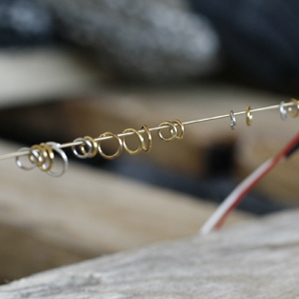
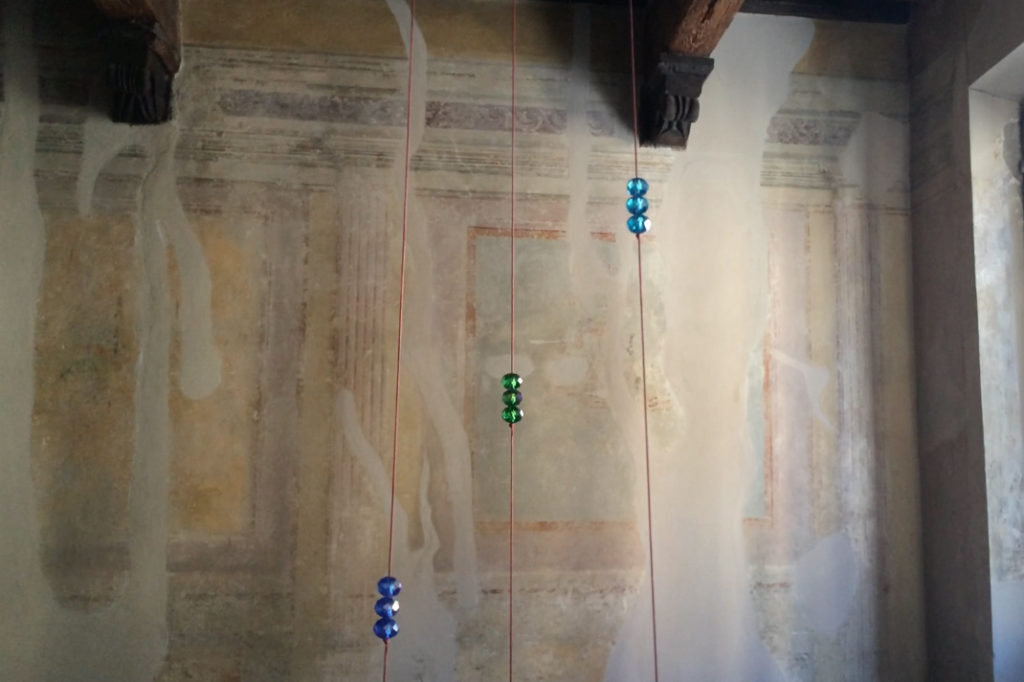
    The vibrations set heterogeneous materials into motion. Golden and silver rings, guitar strings, nylon and cotton threads, beads, and aluminum structures generate a vibrating and unstable body composed of minute intertwined elements that animate and resonate according to the frequencies passing through them. The installation reflects on the transformation of sound into vibration, allowing the frequencies of collective experience to become visible. Each time, the work reassembles itself around different materials, memories, acoustics, and spatial configurations. Over time, Chincaglierie has taken on multiple forms and configurations, adapting itself to different spaces and contexts. From former industrial buildings connected to the textile history of Prato to the seventeenth-century spaces of Casa Masaccio and Casa Giovanni Mannozzi, from workers’ picket lines animated by chants and collective voices to Villa Galileo, where the work responded to cosmic signals and astrophysical soundscapes, the installation continuously reconfigures its materials, acoustics, and spatial relations according to the environment it inhabits.

    Each iteration becomes a temporary assemblage of vibrations, materials, memories, and infrastructures. The work remains open, responsive, and resonant.

    See Project

    11144985_10206794062880429_4480969737470318666_n

    _mg_2737

    Video by ioGim (www.iogim.com)

  • Cartographies

    Cartographies

    Cartographies – Alex, Longyan/Prato

    This work is about geography and it could be shaped in relation to personal life trajectories. I put two different geographical maps one on the top of the other, setting a correspondence between the places on the first and those on the second.

    Alex is at the center of the relationship between the two maps: indeed the first map is the map of the city from which Alex come from, that is Longyan in the south-est of China, the other one is the map of the city where Alex lives now, that is Prato, Tuscany. Moreover Alex’ home in Longyan is superimposed to Alex home in Prato, and this establishes an unique corrispondence between the two maps (the scale of the maps are set equal). After this process I asked Alex to choose some places in Longyan relevant for him: then the matching places according to the process explained above are marked on the Prato map.

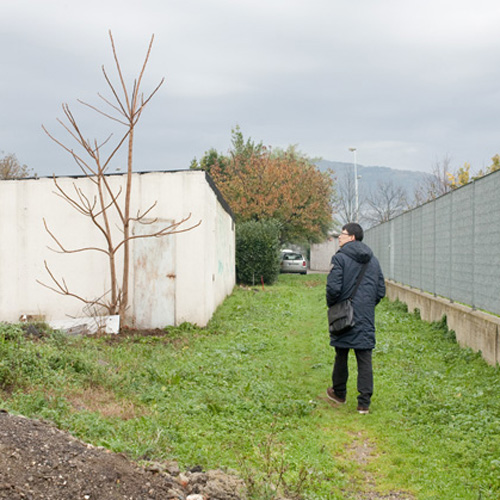
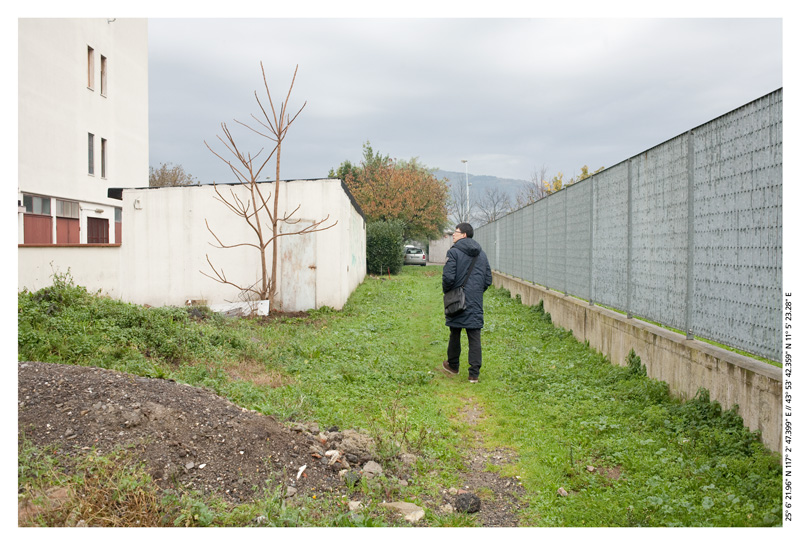
    Then we made together a journey to those marked place in Prato, but pretending to be in Longyan. So I could take photographs of Alex walking in Longyan with almost no travel cost.

    The work is composed by 5 color photographs: a xerox copy of a map and a text about our journey is distributed to the audience.

    Here the critical text by Martino Margheri.

  • Camouflage II

    Camouflage II

    Camouflage II, photograph, written declaration, 2010
    This work has been conceived for the exhibition “Prevenire la cura” at 26cc gallery, Rome (http://www.26cc.org/). The intention of the exhibition is to show some curatorial project that have never been realized. One of them was the Stefano Taccone’s idea of organizing an exhibition inside the US Army base of Camp Darby, in Pisa, Tuscany. This piece follows this idea and has been realized with the help of Augusto Buzzegoli.
    ——————————————
    DECLARATION
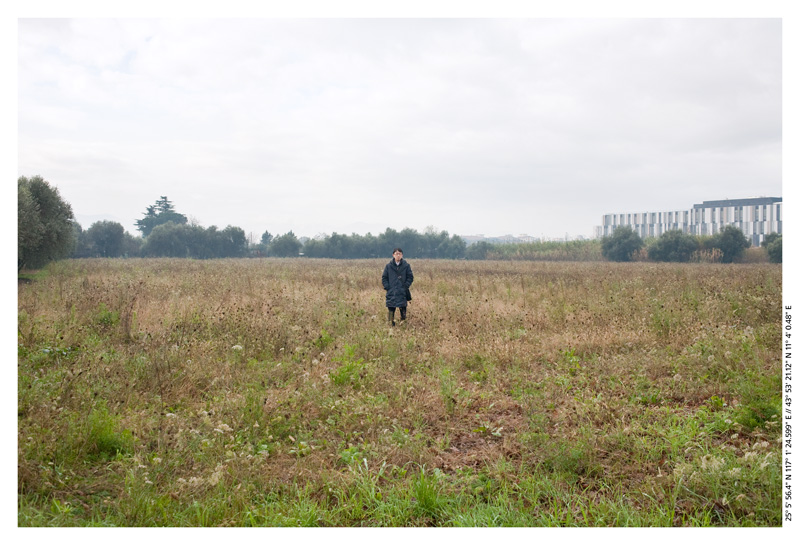
    Thursday, December 09, 2010, 7:06 PM. I entered the military base territorial limits. This selfportrait can be used as a proof. A witness (A. Buzzegoli) confirms this statement. The photograph was shot with a 1/25 sec time exposition, faster than the time frame of the security cameras.

  • Dancing in the dark

    Dancing in the dark

    Dancing in the dark, dance performance, total darkness, 3 cigarettes, 3 dancers, 2010

    Experiments are designed to isolate how we understand our understanding, and how we perceive perception, when all that is certain is that neither can be certain.”
(Peggy Phelan, Unmarked – the politics of performance)
    The Dancing in the dark project is about a simple idea, that is cutting the visual aspect out of a dance piece, by means of the darkness.
Indeed three dancers, black suited, dance in total darkness, and at the end, when the light turns on the stage is found empty. Thus the public can feel, can imagine their presence but cannot see almost anything.
This performance is actually an experiment, to see what happens if unusual conditions are set and different premises are put into action.
    The project is born inside the exhibition I’ll never give up smoking, curated by Alba Braza Boils.
The dancers who took part in the experiment were Enrico L’Abbate, Claudia Mannelli, Elisa Romagnani.

  • Sarajevo Walking Tours

    Sarajevo Walking Tours

    05-swt-valentinalapolla

    Sarajevo Walking Tours, performance/guided tour, 2014.

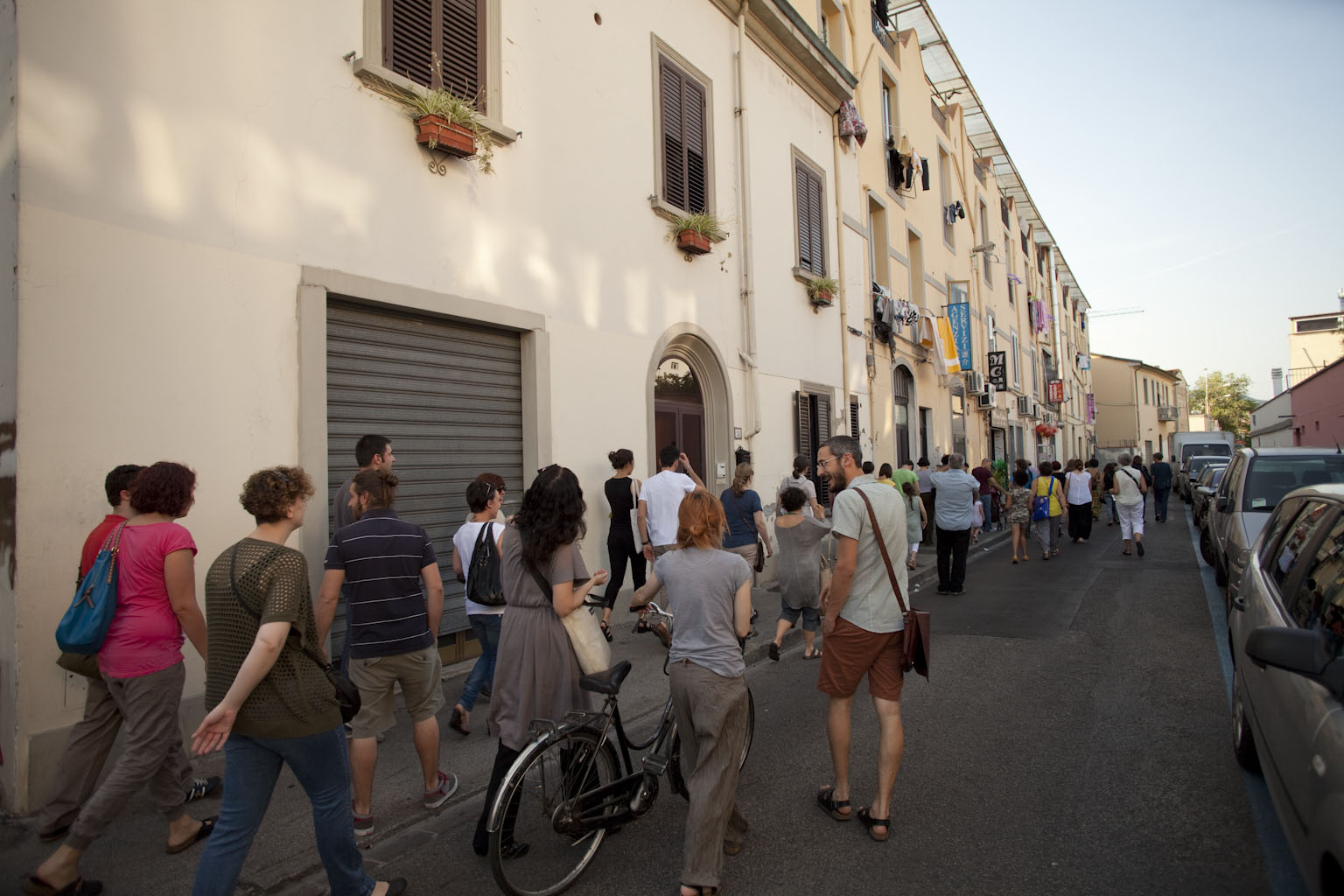
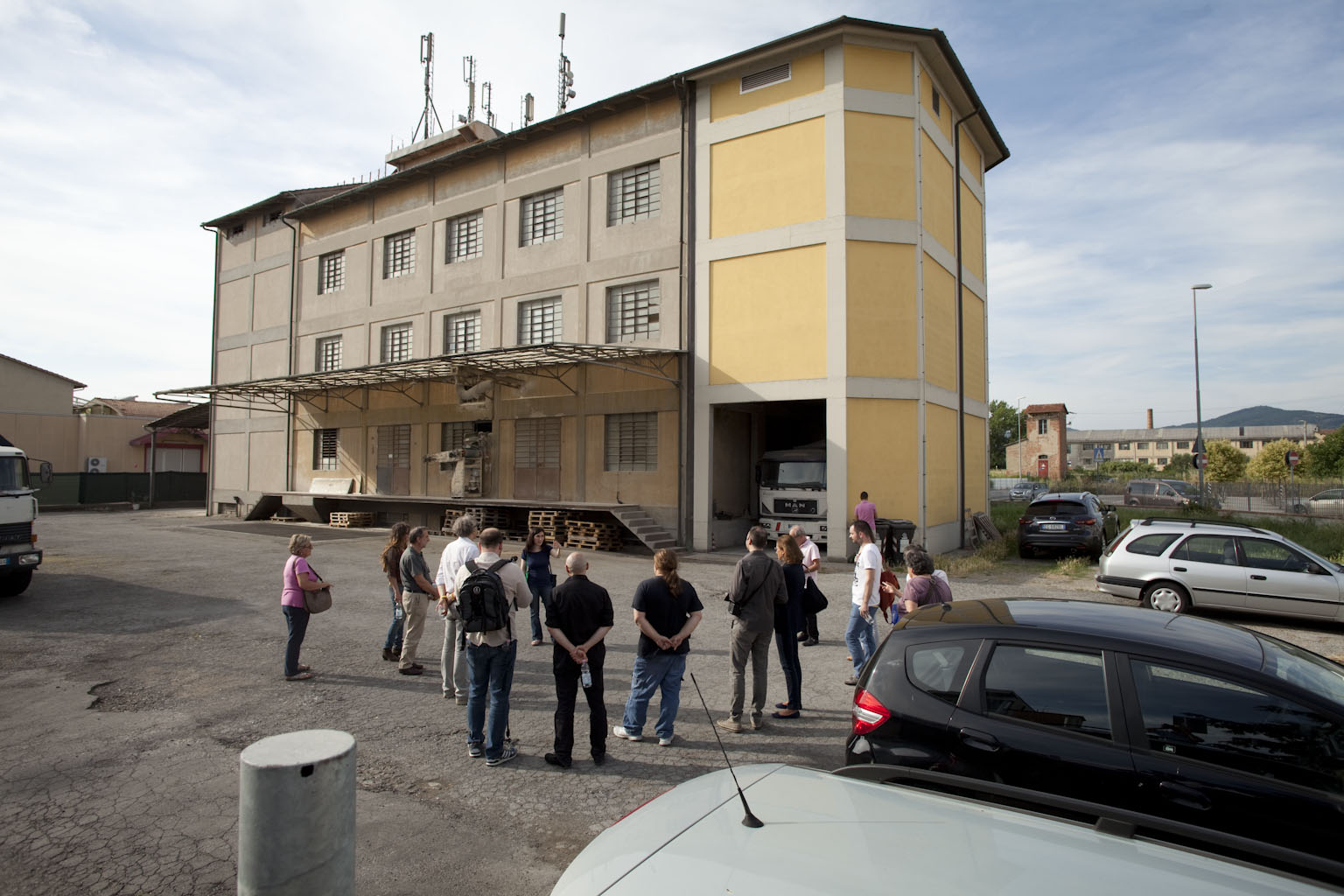
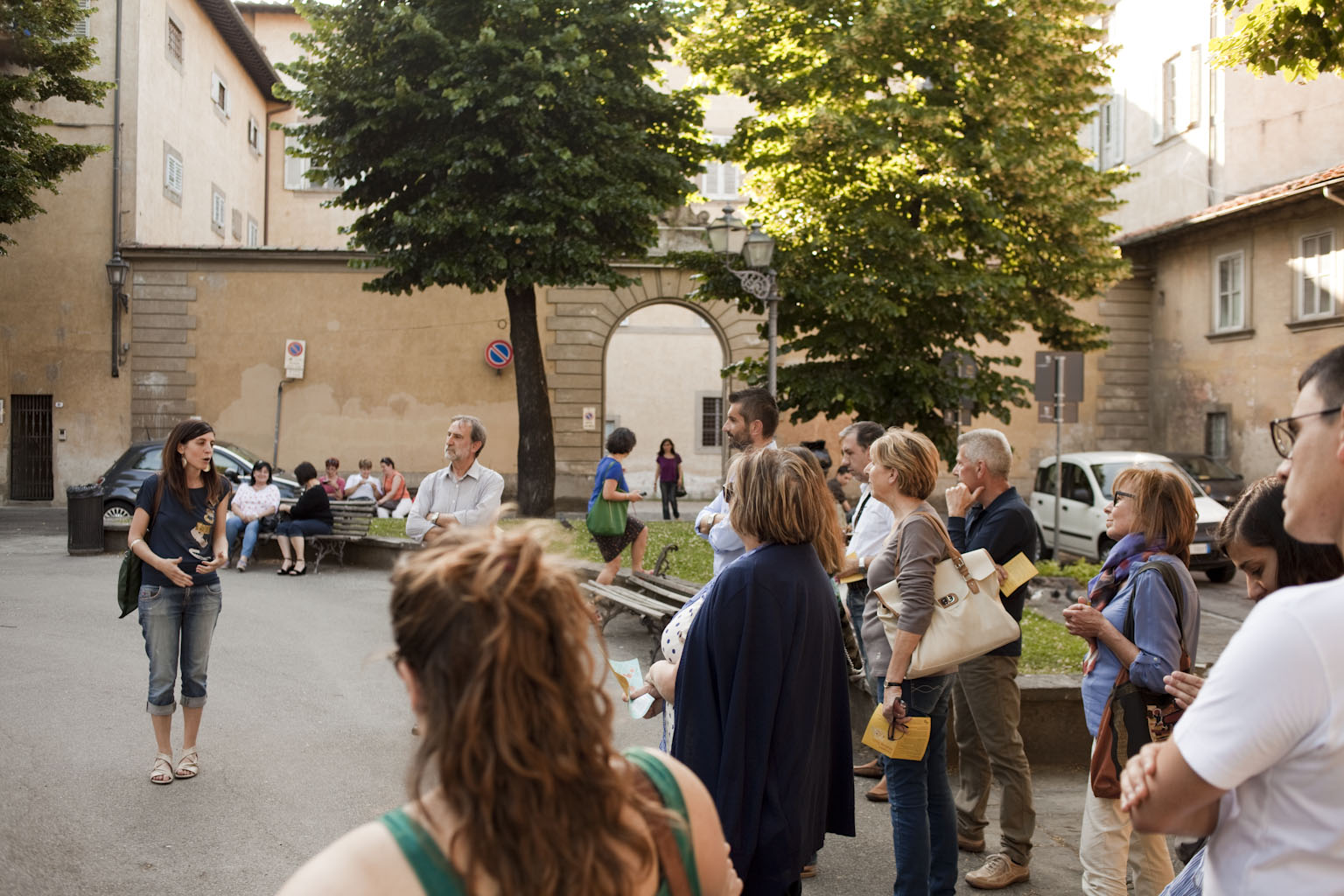
    “Sarajevo Walking Tours” was a three-day guided tour to discover Sarajevo walking through Prato. The streets of Prato, the architecture, the landscape are used to imagine Sarajevo. The two cities were physically connected by an overlay of their respective maps.
    Three different travel itineraries were covered during the three days. First the historic center, the Latin Bridge, The National Library, the churches, the mosquees, the synagogues, simbols of a multiconfessional city; the second day was dedicated to Marijndvor, the frontline during the siege of the city; finally the new city center along the Milijacka river.  Every day, for two hours, we walked through one city in search of another: the National Library in a building under restoration; the National Theatre of Sarajevo in a monumental cemetery in Prato; the Orthodox Church in a monastery; the Jewish Museum in the courtyard of the palace which houses a choir. The places were paired according to the established rule by placing one map on top of the other, at the same scale, so the distance we did was the real distance between two places in Sarajevo.

    During the guided tours some actors read texts about Sarajevo; moreover some acustical suggestion was added, like a musical performance of Albinoni Adagio, remembering the mourning made by the cello player Vedran Smailović after the burning of the National LIbrary, or some audio pieces extracted from original footage of the war provided by Sanel Agic, a Sarajevo boy during the siege, now living in Prato.

    Because we were seeing Prato and listening Sarajevo.

    I asked other artists to add their personal contribution in some places of the guided tours; Raffaele di Vaia performance Insetti consisting in drawing insects in the Sniper Alley; Franco Menicagli that put his new sculpture in the Museum of Contemporary Art of Sarajevo, with a main collection of more than 130 works of international artists and no building to show them. The two cities recalled one another, as a game of mirrors.
    01-swt-valentinalapolla

    06-swt-valentinalapolla

    09-swt-valentinalapolla

    12-swt-valentinalapolla

    13-swt-valentinalapolla

    This work was conceived for the project Prato Sarajevo – Art Invasion, curated by the Pecci Center of Contemporary art, Dryphoto arte contemporanea, Kinkaleri and in collaboration with the The museum of Contemporary Art of Sarajevo, ARS AEVI. The main aim of the project was to connect the Italian and the Bosnian cities, addressing pressing issues in a social, political, and historical climate.

    Tours guides: Alessia Cecconi, Alessio Zipoli, Massimo Bressan, Attilio Maltinti, Giusi Cappellini, Stella Carbone, Vittoria Ciolini.

    Texts and music performed by: Cristina Abati, Sanel Agic, Francesco Rotelli, Francesco Mancini.

    Artistic contribution: Raffaele di Vaia, Franco Menicagli, Chiara Bettazzi, Tatiana Villani e Manuel Perna.

    Photo by Andrea Abati

    Review on NYR magazine. http://notasyreflexiones.com/article-guide-valentina-lapolla/
  • Arsine (Ethiopian Trilogy I)

    Arsine (Ethiopian Trilogy I)

    The Second Italo–Ethiopian War (1935-1936) is an almost forgotten chapter of italian collective memory: it is often recalled as a little exotic conflict, almost erased from the memory of the dramatic events of WW2. Instead in this conflict, strictly tied with the imperial fascist dream, the psychological and emotional involvement of the Italians was more than what Italian people were able to admit at the end of the war.

    This video is focused on a specific issue of this war: the heavy use of chemical weapons by the Italian army, in open violation of international laws (Geneva protocol, 1925). This crime, despite at the time being denounced at international level by the ethiopic emperor Hailè Selassiè, was openly admitted by the italian government only in 1996.

    The dominant racism and the rhetoric of the war of civilization against a barbarian enemy made use of an impressive propagandistic machine and was the moral excuse of the genocide, a dynamics that will repeat many times since then to present times.

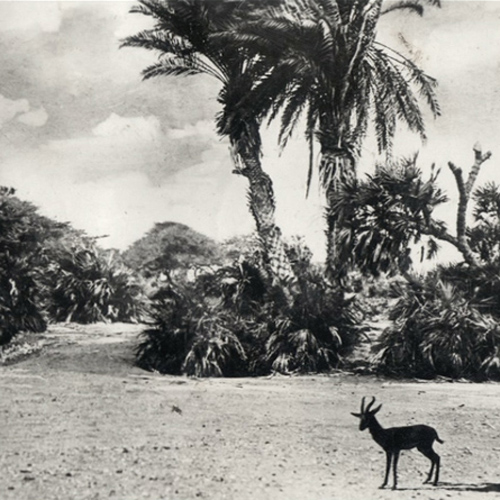
    I took the images composing the video from a photographic album belonging to my family, where my mum’s uncle collected  the images taken in his two years of war in Africa. Over these images, depicting a still landscape where immobility and a disturbing silence are the leading actors, I either reported quotes from Mussolini’s declarations and telegrams or those of the ethiopic emperor and his ras (quoting from “The ethiopic war” by A. Del Boca ).

  • Returnable Empties (Vuoto a rendere)

    Returnable Empties (Vuoto a rendere)

    02-2012-VuotoaRendere

    This project has been conceived and realized for the Portali dello Scompiglio award, in the Tenuta dello Scompiglio, Lucca: the aim of the call was to realize an outdoor installation dealing with the concept of passage between different spaces and areas of the Tenuta.

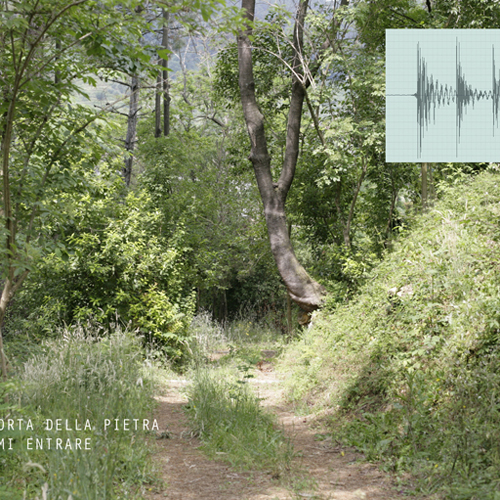
    The project is based on the poem Conversation with a Stone by Wislawa Szymborska. The idea of the self confronting the external world is the essence of the poem. The speaker of the poem repeatedly knocks on a stone’s door trying to enter it, but the stone repeatedly and resolutely refuses: the borders of the “other” have to be respected, and so its radical alterity, rejecting the dominant and imperialist culture that invade other cultures under the guise of seeking knowledge and truth.

    The work consists of a sound installation, totally invisible, situated opposite one of the natural portals of the property. When the visitor passes through the portal they will hear repeated tapping. The sequence they will hear will be random in duration and rhythm, but also in the type of sound. In the woods, waiting and without apparent reason, one hears tapping. Who is it? Where is it coming from? What does it mean? What threshold does it indicate? The sound is like the simplest and yet most enigmatic action. By its very nature and in particular the sound selected, on the threshold of perception, it can be heard only if one pays attention, remains on the edge of presence and absence, an invitation to stay on the threshold and hear more and their differences. An invitation not to think of the space as a void to be conquered by a colonialist that cancels out the other, but to listen to that vibration that resonates in the void (returnable).

    Technical Specification of the Project

    A passive infrared sensor (PIR) detects motion and activates the open source microcontroller Arduino, that generates a random sequence of knocking sound tracks, connected to an amplifier and two loud- speakers. A solar panel provides the electric supply.

    SCOMPIGLIO