
In an era fraught with ecological, social, and political upheaval, the concept of time becomes precarious, prompting us to reconsider its significance. Karen Barad’s writings on quantum physics and temporality became the starting point of this project, opening a reflection on time and its political implications through contemporary debates in quantum physics.
Embarking on a collaborative journey alongside physicists Nicola Poli, Valentina Parigi, Riccardo Sapienza, and Caterina Foti, I ventured into the research laboratories of LENS in Florence and Kastler Brossel in Paris. The project draws its formal and imaginative inspiration from the experiments developed in these laboratories, taking them as a starting point for an artistic reflection on time.
As curator Valeria D’Ambrosio writes, the project attempts to “create correlations between events, situations and people”. These two “time machines” do not propose linear time travel. Instead, they bring laboratory experiments into dialogue with biological rhythms, historical archives, and lived experience, exploring time as something that emerges through situated relations.
Conceived for Villa Galileo, perched on Arcetri hill in Florence, where Galileo Galilei spent the final years of his life under house arrest for his “heretical” views, the project was presented within an exhibition that investigated different forms of relation across science, labour, ecology, feminism, and history.

Every single vibration
electronic devices, led matrix, flexible led filaments, glass laser tubes, volcanic rocks, glass lenses, mechanic clock mechanism, mud, bacteria, chicken wire, speakers, sensors, color photograph, celestine crystal, strontium aluminate paint, aluminum profiles, black MDF wood. 100 x 180 x 130 cm.
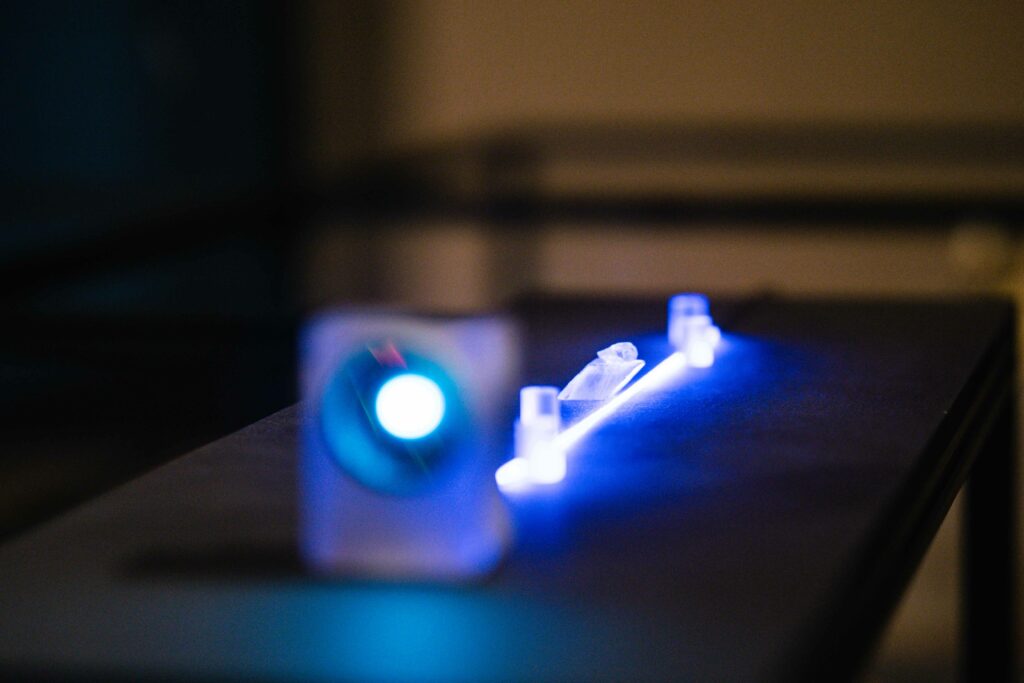
Inspired by the optical atomic clock developed at the LENS laboratory, Every Single Vibration assembles different systems of oscillation and measurement. Historical instruments such as a volcanic rock pendulum and a sundial made from porcupine bristles coexist with biological rhythms generated by geobacter bacterial colonies and the visitor’s own heartbeat. Alice Munro’s The Moons of Jupiter scrolls across an LED matrix following the visitor’s pulse, while the movement of a leaf outside the villa is transmitted through an accelerometer to the machine.
By bringing together heterogeneous temporal rhythms, the work proposes multiple ways of sensing and measuring time, reflecting on temporality as something emerging through the interaction of matter, bodies, technologies, and environments.

Radical experiments in correlation
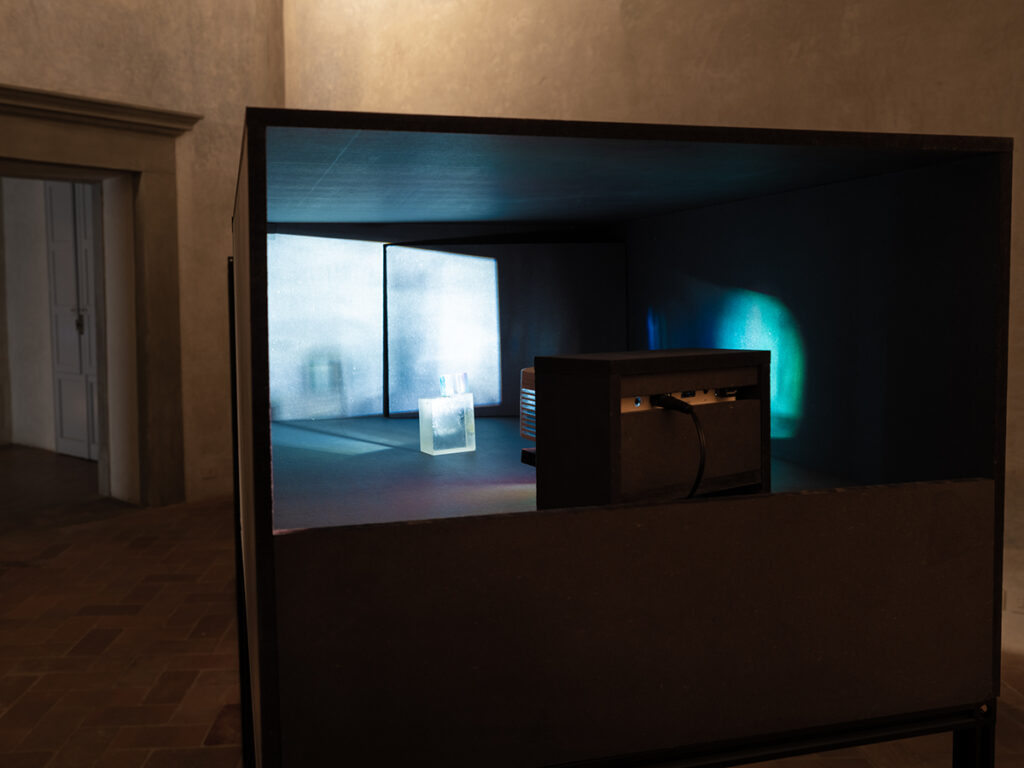
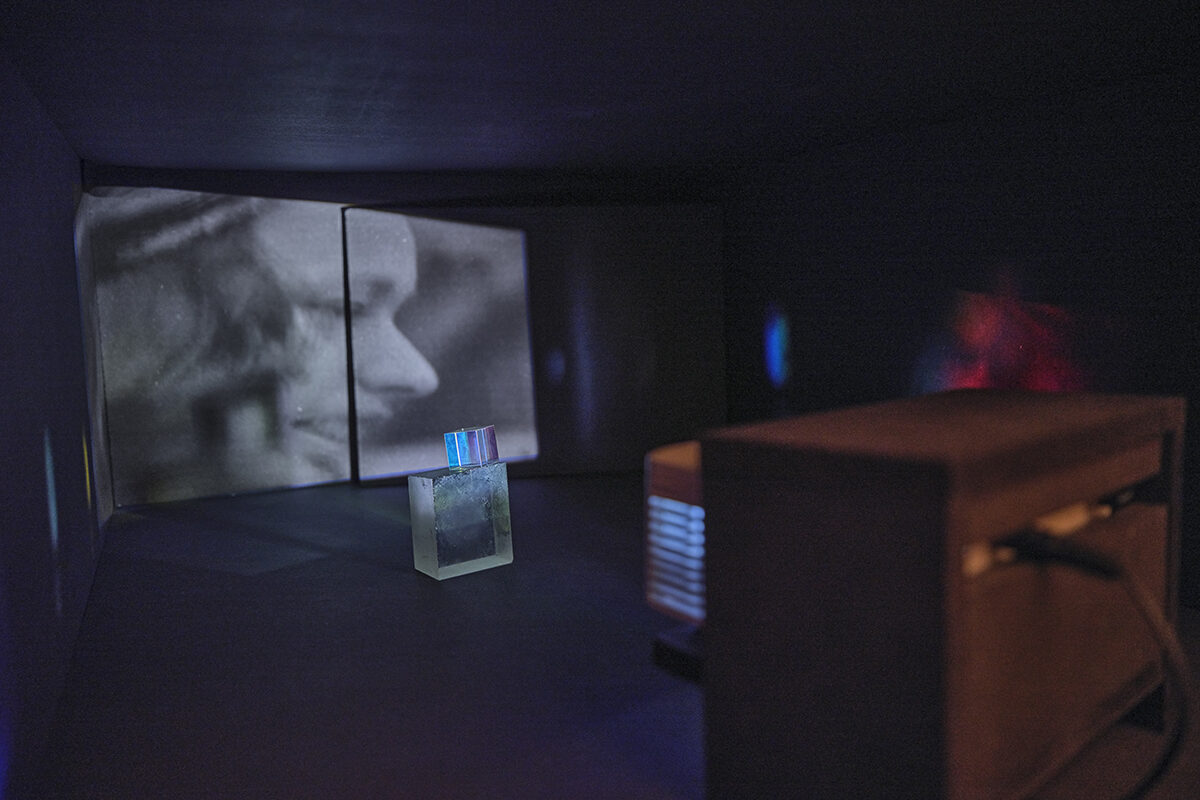
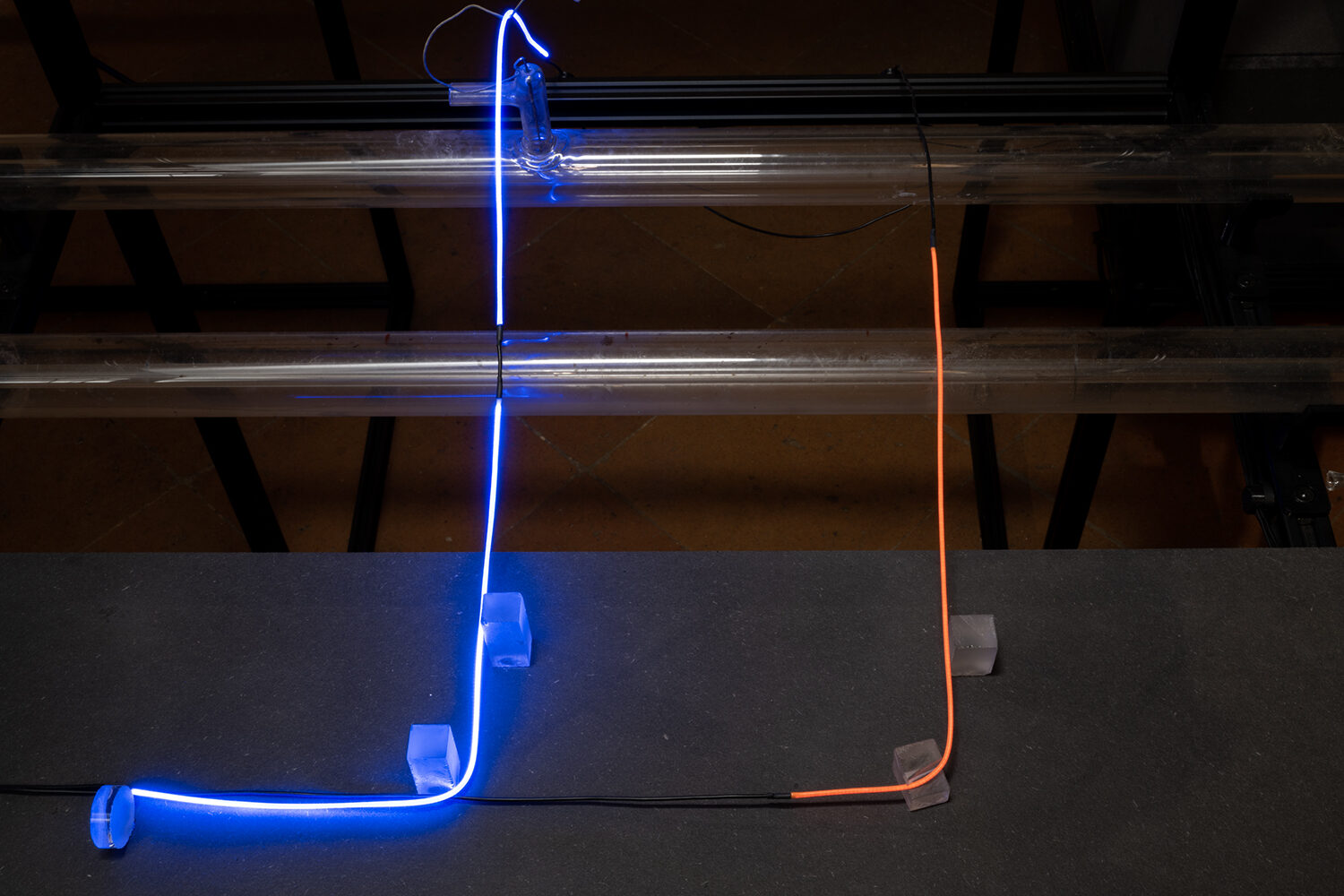
electronic devices, liquid crystal valve, glass pieces, colored wires, silver rings, vibe motors, led matrices, video projector, beam splitters, aluminum profiles, black MDF wood. 50 x 400 x 150 cm
This installation draws inspiration from experiments involving superposition and entanglement and their relation to time. It also stems from the Page and Wootters proposal that time is not a fundamental feature of the world, but may instead emerge from quantum correlations. This possibility places entanglement at the centre of the work’s reflection on temporality.
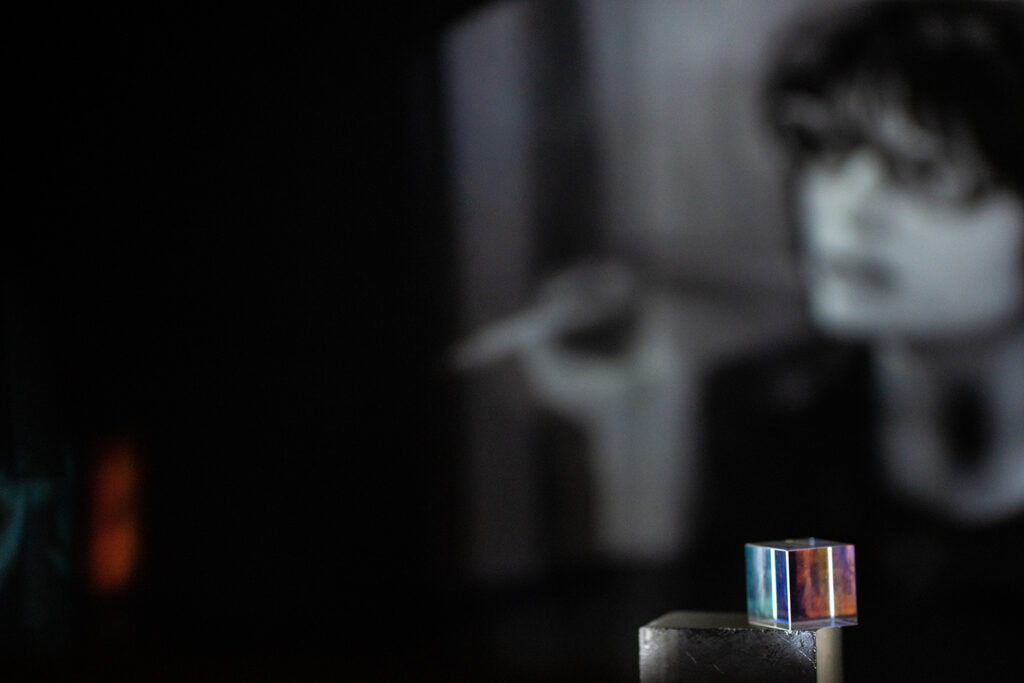
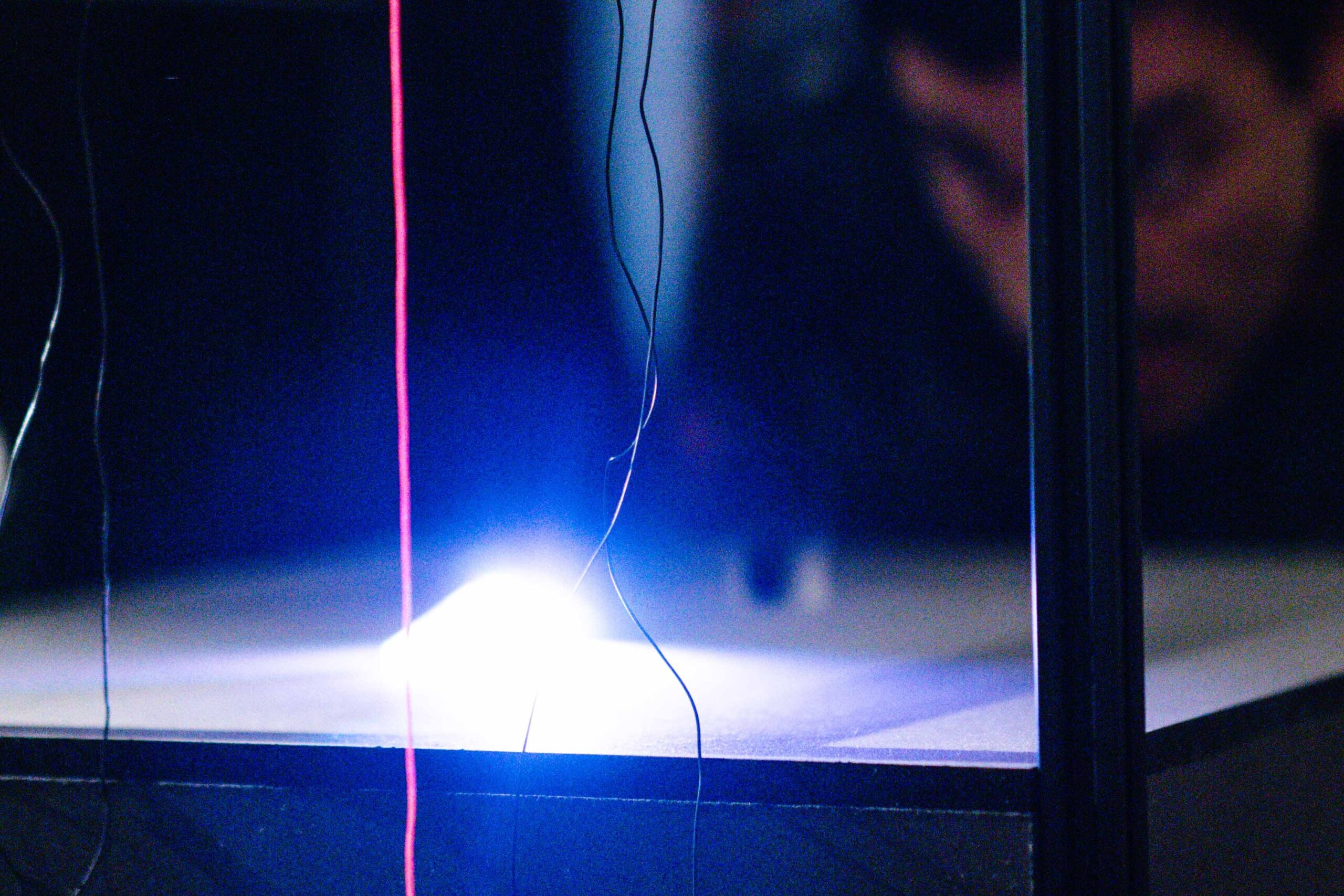
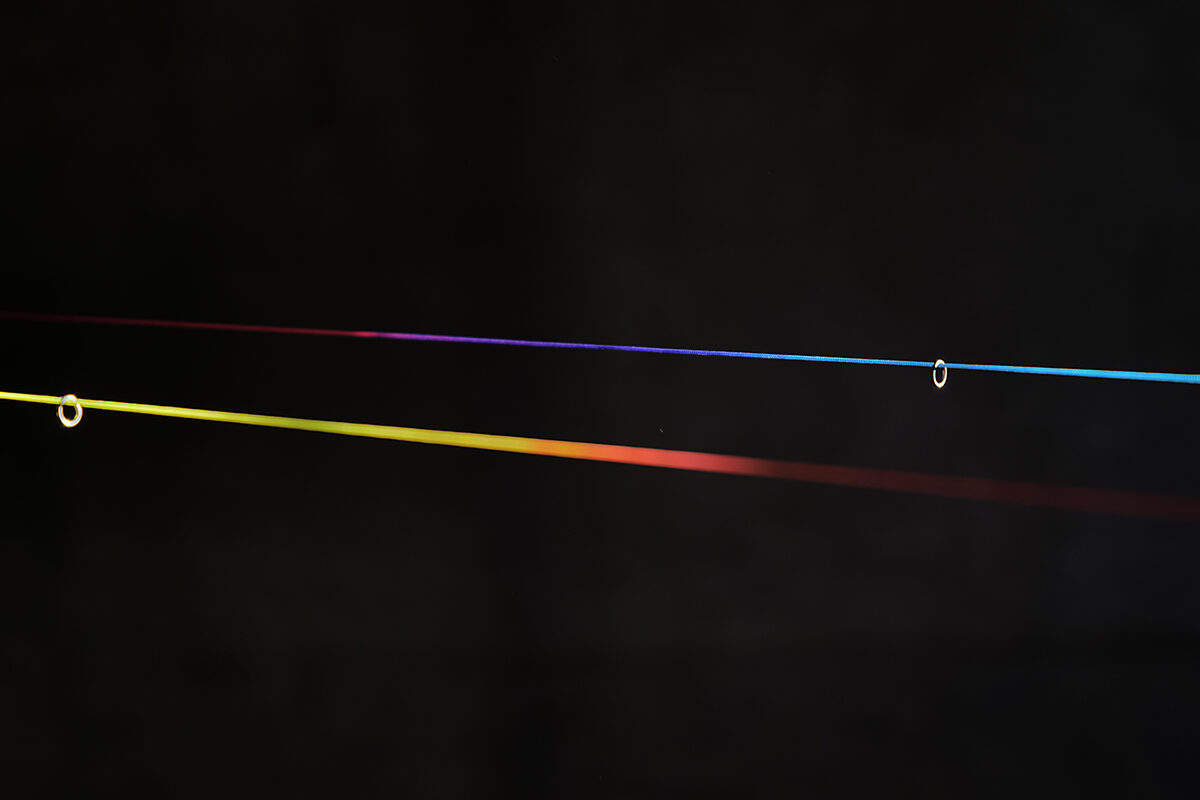
The first section reinterprets a recent experiment by Riccardo Sapienza’s team on the double slit in the time domain, recreating it through a minimalist arrangement in which multicoloured light and oscillating wires evoke interference patterns in the frequency domain. The second section refers to Valentina Parigi’s experiments in Paris, where nonlinear crystals generate entangled states of light. Vibrating rings suspended on coloured strings evoke these correlated photons before leading the viewer into a miniature cinema showing footage from the AAMOD archive, where black and white images are diffracted into colour through beam splitters.
The movement from laboratory experiments to archival images shifts the work from physical correlations to historical and political ones. The feminist struggles preserved in the archive become an example of a collective attempt to transform history by creating enduring forms of solidarity and responsibility. Entanglement is approached here not as a form of universal connectedness, but as a way of reflecting on how relations are consciously produced, maintained, and transmitted across time.
As D’Ambrosio observes, the work ultimately moves “from the complexity of physics to the everyday responsibility that concerns each of us.” In this sense, the installation reflects on time not only as a scientific question, but also as a political one, shaped by the relations we build, sustain, and carry into the future.






An entangled time machine was conceived and realised for the tenth edition of the art and science festival La Science de L’art, organized by the Collectif pour la Culture en Essonne in Sainte-Geneviève-des-Bois, France, in collaboration with the Grasping the Cosmos project, coordinated by Villa Galileo (Museum System of the University of Florence) and the GGI – Galileo Galilei Institute for Theoretical Physics, Florence. An entangled time machine also became the title of Tina Salvadori Paz’s solo exhibition, curated by Valeria D’Ambrosio, hosted at Villa Galileo in Florence in November 2023.
Photo credits for the project: Giulia Lenzi, Andrea Abati, Luca Sguanci
More on Grasping the cosmos